Showing posts with label Jennifer Francis. Show all posts

Care for the Ozone Layer


The stratosphere normally is cold and very dry. Global warming can increase water vapor in the stratosphere in a number of ways. Global warming causes the troposphere to warm and since warmer air holds more water vapor, the amount of water vapor in the troposphere is increasing. This can cause more water vapor to end up in the stratosphere as well, as described below.

Stratospheric Water Vapor over the Arctic

Around the time of the December Solstice, very little sunlight is reaching the Arctic and temperatures over land at higher latitudes can get very low. At the same time, global warming has made oceans warmer and this keeps air temperatures over water relatively warm in Winter. This can lead to a number of phenomena including sudden stratospheric warming and moistening of the stratosphere.

Sudden stratospheric warming is illustrated by the image on the right, showing temperatures in the stratosphere over Siberia as high as 12.7°C or 54.9°F on December 24, 2018, and temperatures as low as -84.8°C or -120.6°F over Greenland.

At the same time, relative humidity was as high as 100% in the stratosphere over the North Sea, as the second image on the right shows.

Moistening of the stratosphere was even more pronounced on December 24, 2016, as illustrated by the third image on the right.

Storms over the U.S.

Jennifer Francis has long pointed out that, as temperatures at the North Pole are rising faster than at the Equator, the Jet Stream is becoming wavier and can get stuck in a 'blocking pattern' for days, increasing the duration and intensity of extreme weather events.

This can result in stronger storms moving more water vapor inland over the U.S., and such storms can cause large amounts of water vapor to rise high up in the sky.

Water vapor reaching stratospheric altitudes causes loss of ozone, as James Anderson describes in a 2017 paper and discusses in the short 2016 video below.


Methane

Stratospheric water vapor can also result from methane oxidation in the stratosphere. Methane concentrations have risen strongly at higher altitudes over the years. Noctilucent clouds indicate that methane has led to water vapor in the upper atmosphere.

The danger is that, as the Arctic Ocean keeps warming, large eruptions of methane will occur from the seafloor. Ominously, high methane levels have recently shown up on satellite images over the Arctic at lower altitudes, indicating the methane is escaping from the sea.

The images below show methane levels recorded by the NPP satellite:
Jan. 6, 2019, with peak levels of 2513 ppb at 1000 mb, 2600 ppb at 840 mb and 2618 ppb at 695 mb;
Jan. 11, 2019, with peak levels of 2577 ppb at 1000 mb, 2744 ppb at 840 mb and 2912 ppb at 695 mb;
Jan. 15, 2019, with peak levels of 2524 ppb at 1000 mb, 2697 ppb at 840 mb and 2847 ppb at 695 mb.


The images below show methane levels recorded by the MetOp satellites:
Jan. 15, 2019, with peak levels of 2177 ppb at 840 mb, 2342 ppb at 695 mb and 2541 ppb at 586 mb;
Jan. 16, 2019, with peak levels of 2219 ppb at 840 mb, 2299 ppb at 695 mb and 2475 ppb at 586 mb;
Jan. 19, 2019, with peak levels of 2201 ppb at 840 mb, 2489 ppb at 695 mb and 2813 ppb at 586 mb.


The Importance of the Ozone Layer

Increases in stratospheric water vapor are bad news, as they speed up global warming and lead to loss of stratospheric ozone, as Drew Shindell pointed out back in 2001.

It has long been known that deterioration of the ozone shield increases ultraviolet-B irradiation, in turn causing skin cancer. Recent research suggest that, millions of years ago, it could also have led to loss of fertility and consequent extinction in plants and animals (see box right).

Existential Threats

In conclusion, rising levels of emissions by people constitute existential threats in many ways. Rising temperatures cause heat stress and infertility, and there are domino effects. Furthermore, stratospheric ozone loss causes cancer and infertility. Only once the ozone layer formed on Earth some 600 million years ago could multicellular life develop and survive. Further loss of stratospheric ozone could be the fastest path to extinction for humanity, making care for the ozone layer imperative.

As described in an earlier post, Earth is on the edge of runaway warming and a moist-greenhouse scenario means oceans are evaporating into the stratosphere with loss of the ozone layer.

The situation is dire and calls for comprehensive and effective action, as described in the Climate Plan.


Links

• Climate and ozone response to increased stratospheric water vapor, by Drew Shindell (2001)
https://agupubs.onlinelibrary.wiley.com/doi/abs/10.1029/1999GL011197

• Stratospheric ozone over the United States in summer linked to observations of convection and temperature via chlorine and bromine catalysis, by James Anderson et al. (2017)
https://www.pnas.org/content/114/25/E4905

• Harvard Speaks on Climate Change: James Anderson (2016)
https://vimeo.com/185794598

• Climate Week: Climate Science Breakfast with James Anderson (April 9, 2015)
http://environment.harvard.edu/climate-week-climate-science-breakfast-james-anderson

• 10°C or 18°F warmer by 2021?
https://arctic-news.blogspot.com/2017/04/10c-or-18f-warmer-by-2021.html

• Noctilucent clouds indicate more methane in upper atmosphere
https://arctic-news.blogspot.com/2012/09/noctilucent-clouds-indicate-more-methane-in-upper-atmosphere.html

• Noctilucent clouds: further confirmation of large methane releases
https://methane-hydrates.blogspot.com/2013/12/noctilucent-clouds-further-confirmation-of-large-methane-releases.html

• It could be unbearably hot in many places within a few years time
https://arctic-news.blogspot.com/2016/07/it-could-be-unbearably-hot-in-many-places-within-a-few-years-time.html

• Climate change: effect on sperm could hold key to species extinction, by Kris Sales
https://theconversation.com/climate-change-effect-on-sperm-could-hold-key-to-species-extinction-107375

• Climate change: effect on sperm could hold key to species extinction
https://theconversation.com/climate-change-effect-on-sperm-could-hold-key-to-species-extinction-107375

• UV-B–induced forest sterility: Implications of ozone shield failure in Earth’s largest extinction, by Jeffrey Benca et al. (2018)
http://advances.sciencemag.org/content/4/2/e1700618

• Co-extinctions annihilate planetary life during extreme environmental change, by Giovanni Strona and Corey Bradshaw (2018)
https://www.nature.com/articles/s41598-018-35068-1

• Earth is on the edge of runaway warming
https://arctic-news.blogspot.com/2013/04/earth-is-on-the-edge-of-runaway-warming.html

• Climate Plan
https://arctic-news.blogspot.com/p/climateplan.html


Is warming in the Arctic behind this year's crazy winter weather?

Is warming in the Arctic behind this year's crazy winter weather?

File 20180111 101511 sa3hd1.jpg?ixlib=rb 1.1
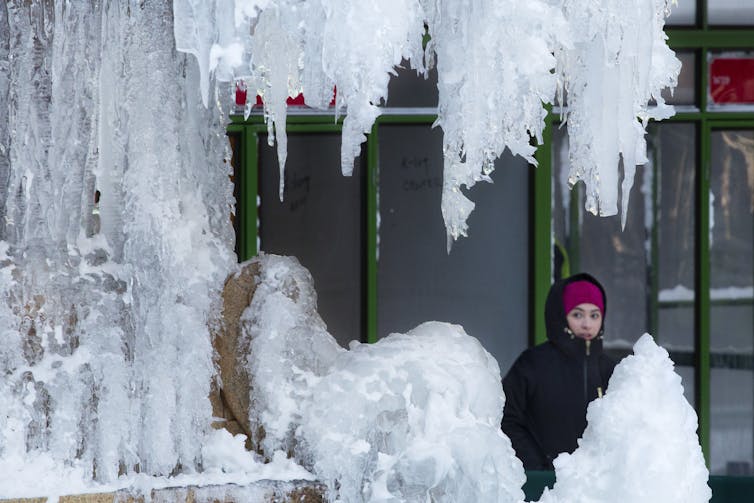
Seriously cold: The ‘bomb cyclone’ freezes a fountain in New York City.
AP Photo/Mark Lennihan
Jennifer Francis, Rutgers University

Damage from extreme weather events during 2017 racked up the biggest-ever bills for the U.S. Most of these events involved conditions that align intuitively with global warming: heat records, drought, wildfires, coastal flooding, hurricane damage and heavy rainfall.

Paradoxical, though, are possible ties between climate change and the recent spate of frigid weeks in eastern North America. A very new and “hot topic” in climate change research is the notion that rapid warming and wholesale melting of the Arctic may be playing a role in causing persistent cold spells.

It doesn’t take a stretch of the imagination to suppose that losing half the Arctic sea-ice cover in only 30 years might be wreaking havoc with the weather, but exactly how is not yet clear. As a research atmospheric scientist, I study how warming in the Arctic is affecting temperature regions around the world. Can we say changes to the Arctic driven by global warming have had a role in the freakish winter weather North America has experienced?

A ‘dipole’ of abnormal temperatures

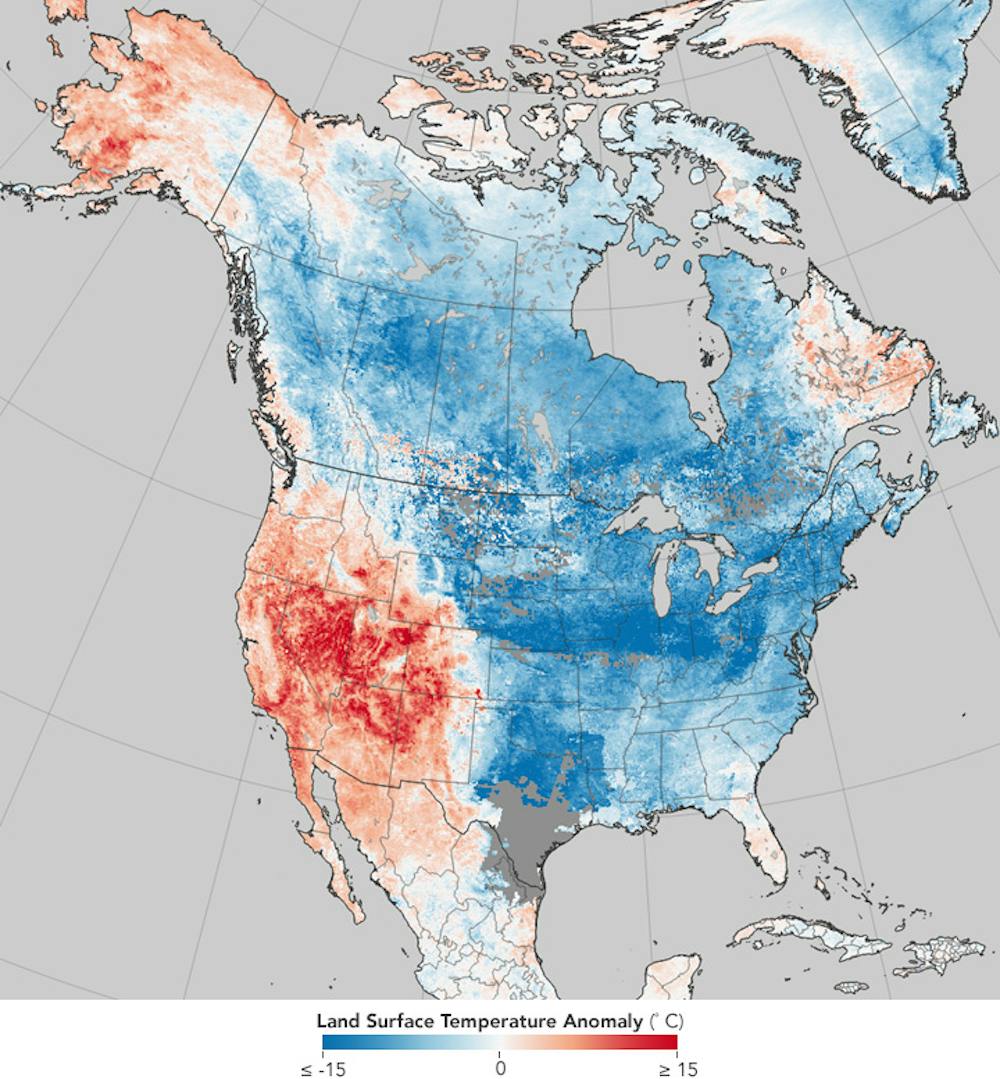
Weird and destructive weather was in the news almost constantly during 2017, and 2018 seems to be following the same script. Most U.S. Easterners shivered their way through the end of 2017 into the New Year, while Westerners longed for rain to dampen parched soils and extinguish wildfires. Blizzards have plagued the Eastern Seaboard – notably the “bomb cyclone” storm on Jan. 4, 2018 – while California’s Sierra Nevada stand nearly bare of snow.
A study in contrasts: Warming near Alaska and the Pacific Ocean are ‘ingredients’ to a weather pattern where cold air from the Arctic plunges deep into North America.
NASA Earth Observatory, CC BY
This story is becoming a familiar one, as similar conditions have played out in four of the past five winters. Some politicians in Washington D.C., including President Trump, have used the unusual cold to question global warming. But if they looked at the big picture, they’d see that eastern cold spells are a relative fluke in the Northern Hemisphere as a whole and that most areas are warmer than normal.

A warm, dry western North America occurring in combination with a cold, snowy east is not unusual, but the prevalence and persistence of this pattern in recent years have piqued the interests of climate researchers.

The jet stream – a fast, upper-level river of wind that encircles the Northern Hemisphere – plays a critical role. When the jet stream swoops far north and south in a big wave, extreme conditions can result. During the past few weeks, a big swing northward, forming what’s called a “ridge” of persistent atmospheric pressure, persisted off the West Coast along with a deep southward dip, or a “trough,” over the East.

New terms have been coined to describe these stubborn features: “The North American Winter Temperature Dipole,” the “Ridiculously Resilient Ridge” over the West, and the “Terribly Tenacious Trough” in the East.
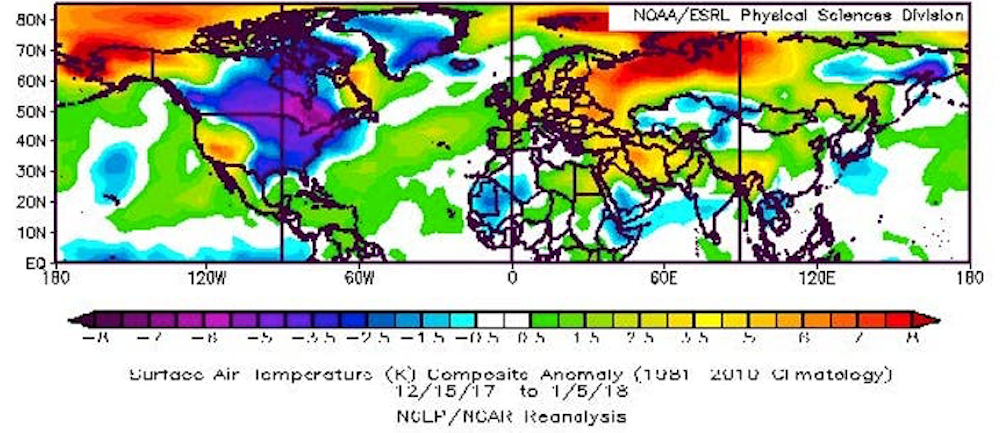
While the eastern U.S. suffered very cold temperatures in the recent cold snap, much of the rest of the Northern Hemisphere saw higher-than-average air temperatures.
NOAA, CC BY

Regardless what it’s called, this dipole pattern – abnormally high temperatures over much of the West along with chilly conditions in the East – has dominated North American weather in four of the past five winters. January 2017 was a stark exception, when a strong El Niño flipped the ridge-trough pattern, dumping record-breaking rain and snowpack on California while the east enjoyed a mild month.

Two other important features are conspicuous in the dipole temperature pattern: extremely warm temperatures in the Arctic near Alaska and warm ocean temperatures in the eastern Pacific. Several new studies point to these “ingredients” as key to the recent years with a persistent dipole.

It takes two to tango

What role does warming – specifically the warming ocean and air temperatures in the Arctic – play in this warm-West/cool-East weather pattern? The explanation goes like this.

Pacific Ocean temperatures fluctuate naturally owing to short-lived phenomena such as El Niño/La Niña and longer, decades-length patterns. Scientists have long recognized that those variations affect weather patterns across North America and beyond.
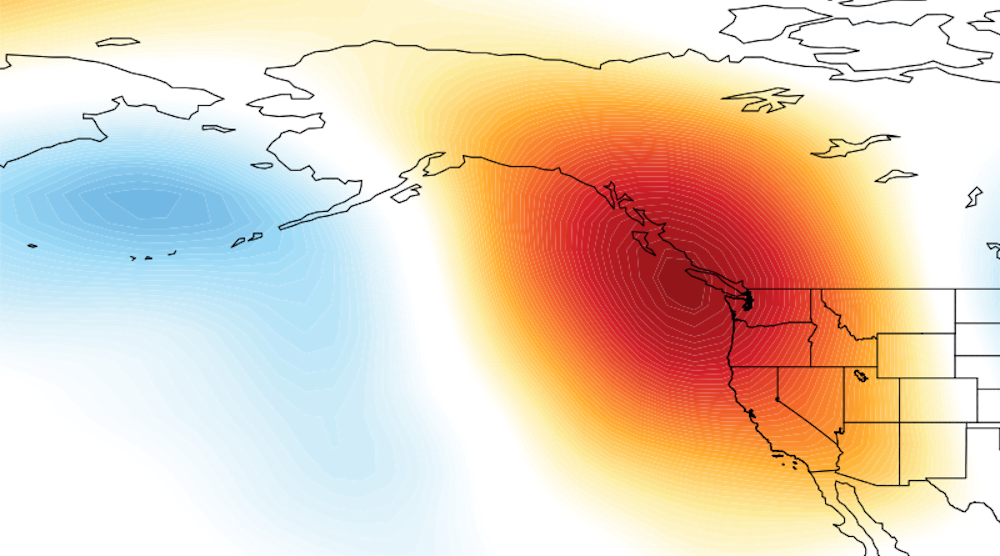
When a persistent area of atmospheric pressure stays in the western U.S., air from the Arctic pours into the U.S, causing a split between the warm and dry West and the cold East.
Mesocyclone2014 and David Swain, CC BY-SA

The new twist in this story is that the Arctic has been warming at at least double the pace of the rest of the globe, meaning that the difference in temperature between the Arctic and areas farther south has been shrinking. This matters because the north/south temperature difference is one of the main drivers of the jet stream. The jet stream creates the high- and low-pressure systems that dictate our blue skies and storminess while also steering them. Anything that affects the jet stream will also affect our weather.

When ocean temperatures off the West Coast of North America are warmer than normal, as they have been most of the time since winter 2013, the jet stream tends to form a ridge of high pressure along the West Coast, causing storms to be diverted away from California and leaving much of the West high and dry.

If these warm ocean temperatures occur in combination with abnormally warm conditions near Alaska, the extra heat from the Arctic can intensify the ridge, causing it to reach farther northward, become more persistent, and pump even more heat into the region near Alaska. And in recent years, Alaska has experienced periods of record warm temperatures, owing in part to reduced sea ice.

My colleagues and I have called this combination of natural and climate change-related effects “It Takes Two to Tango,” a concept that may help explain the Ridiculously Resilient Ridge observed frequently since 2013. Several new studies support this human-caused boost of a natural pattern, though controversy still exists regarding the mechanisms linking rapid Arctic warming with weather patterns farther south in the mid-latitudes.

More extreme weather ahead?

In response to the strengthened western ridge of atmospheric pressure, the winds of the jet stream usually also form a deeper, stronger trough downstream. Deep troughs act like an open refrigerator door, allowing frigid Arctic air to plunge southward, bringing misery to areas ill-prepared to handle it. Snowstorms in Texas, ice storms in Georgia and chilly snowbirds in Florida can all be blamed on the Terribly Tenacious Trough of December 2017 and January 2018.
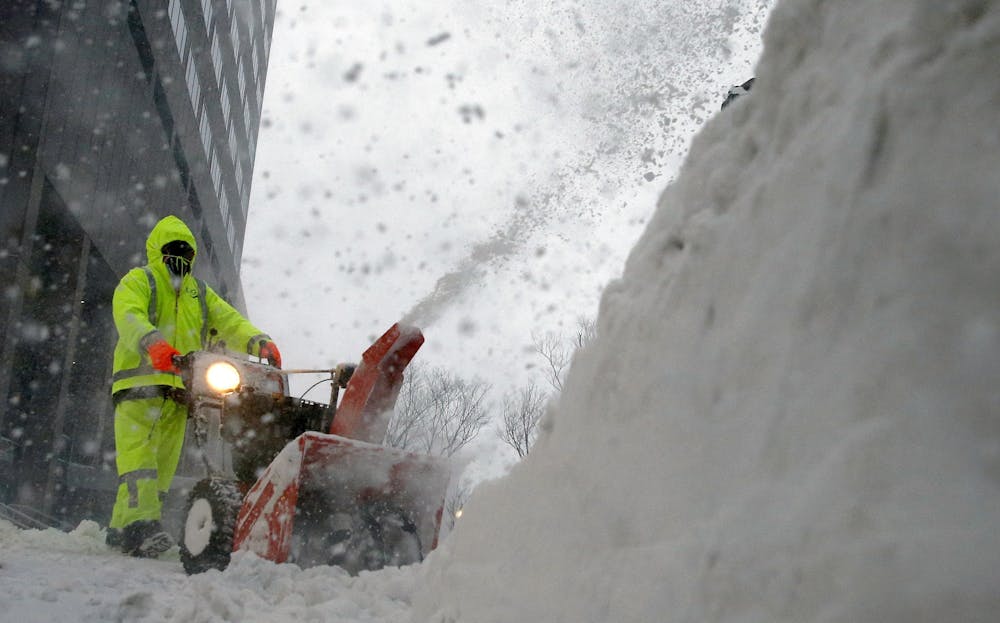
Cold weather from the Arctic combined with warm tropical air fueled a storm that produced well over a foot of snow and spots of flooding in Boston.
AP Photo/Michael Dwyer
Adding icing on the cake is the tendency for so-called “nor’easters,” such as the “bomb cyclone” that struck on Jan. 4, to form along the East Coast when the trough’s southwest winds align along the Atlantic Seaboard. The resulting intense contrast in temperature between the cold land and Gulf Stream-warmed ocean provides the fuel for these ferocious storms.

The big question is whether climate change will make dipole patterns – along with their attendant tendencies to produce extreme weather – more common in the future. The answer is yes and no.

It is widely expected that global warming will produce fewer low-temperature records, a tendency already observed. But it may also be true that cold spells will become more persistent as dipole patterns intensify, a tendency that also seems to be occurring.

It’s hard to nail down whether this weather pattern – overall warmer winters in North America but longer cold snaps – will persist. Understanding the mechanisms behind these complex interactions between natural influences and human-caused changes is challenging.

The ConversationNevertheless, research is moving forward rapidly as creative new metrics are developed. Our best tools for looking into the future are sophisticated computer programs, but they, too, struggle to simulate these complicated behaviors of the climate system. Given the importance of predicting extreme weather and its impacts on many aspects of our lives, researchers must continue to unravel connections between climate change and weather to help us prepare for the likely ongoing tantrums by Mother Nature.

Jennifer Francis, Research Professor, Rutgers University

This article was originally published on The Conversation. Read the original article.

The Arctic is Changing the Jet Stream - Why This Is Important

By Sam Carana, with contributions by Jennifer Francis

Global warming is increasing the strength of hurricanes. A warmer atmosphere holds more water vapor and sea surface temperatures are rising. Both of these changes strengthen hurricanes. Steering winds may also be changing, causing unusual hurricane tracks such as Sandy's left turn into the mid-Atlantic seaboard and Harvey's stagnation over Houston. Is rapid Arctic warming playing a role?

Jennifer Francis has long been warning that global warming is increasing the likelihood of wavier jet stream patterns and more frequent blocking events, both of which have been observed. The Arctic is warming more rapidly than the rest of the world. The narrowing temperature difference between the Arctic and lower latitudes is weakening the speed at which the jet stream circumnavigates Earth and may be making the jet stream more wavy. In a 2012 study, Jennifer Francis and Stephen Vavrus warned that this makes atmospheric blocking events in the Northern Hemisphere more likely, aggravating extreme weather events related to stagnant weather conditions, such as drought, flooding, cold spells, and heat waves.

The danger was highlighted later that year, when a strong block associated with a deep jet stream trough helped steered Hurricane Sandy toward New York. In 2017, Hurricane Harvey hovered over Houston and dumped record-breaking rains (over 50 inches in some locations!), again highlighting this danger.

The jet stream separates cold air in the Arctic from warmer air farther south. A wavier jet stream transports more heat and moisture into the Arctic. This speeds up warming of the Arctic in a number of ways. In addition to warming caused by the extra heat, the added water vapor is a potent greenhouse gas, trapping more heat in the atmosphere over the Arctic, while it also causes more clouds to form that also are effective heat trappers.

As the Arctic keeps warming, the jet stream is expected to become more distorted, bringing ever more heat and moisture into the Arctic. This constitutes a self-reinforcing feedback loop that keeps making the situation worse. In conclusion, it's high time for more comprehensive and effective action to reduce the underlying culprit: global warming.


Jennifer Francis is Research Professor at the Institute of Marine and Coastal Sciences at Rutgers University, where she studies Arctic climate change and the link between the Arctic and global climates.

Jennifer has received funding from the National Science Foundation and NASA. She is a member of the American Meteorological Society, American Geophysical Union, Association for Women in Science and the Union of Concerned Scientists.


Links

• Evidence Linking Arctic Amplification to Extreme Weather in Mid-Latitudes, by Jennifer Francis and Stephen Vavrus (2012)
http://onlinelibrary.wiley.com/doi/10.1029/2012GL051000/full

• Why Are Arctic Linkages to Extreme Weather Still Up in the Air? By Jennifer Francis (July 7, 2017)
http://journals.ametsoc.org/doi/abs/10.1175/BAMS-D-17-0006.1

• Amplified Arctic warming and mid‐latitude weather: new perspectives on emerging connections, by Jennifer Francis, Stephen Vavrus, Judah Cohen (May 16, 2017)
http://wires.wiley.com/WileyCDA/WiresArticle/wisId-WCC474.html

• Jennifer Francis: A New Arctic Feedback - interview with Peter Sinclair
https://www.youtube.com/watch?v=R_q3uWQR8Mw

• Jennifer Francis - Understanding the jet stream
https://www.youtube.com/watch?v=_nzwJg4Ebzo

Arctic Ocean Feedbacks


The world is warming rapidly, and the Arctic is warming much more rapidly than the rest of the world. In December 2016, the temperature anomaly from latitude 83°N to the North Pole was 8 times as high as the global anomaly. Above forecast for February 6, 2017, shows that temperatures over parts of the Arctic Ocean will be as much as 30°C or 54°F higher than they were in 1979-2000. How can it be so much warmer in a place where, at this time of year, little or no sunlight is shining? The Arctic Ocean is warming particularly rapidly due to a multitude of feedbacks, some of which are illustrated on the image below.


As the Arctic is warming more rapidly than the rest of the world, the temperature difference between the Arctic and the northern latitudes decreases, which makes the jet stream wavier. Jennifer Francis has written extensively about jet stream changes as a result of rapid warming in the Arctic. In the video below, Peter Sinclair interviews Jennifer Francis on these changes.


The changes to the jet stream make it easier for warm air from the south to enter the Arctic and for cold air to move out of the Arctic deep down into North America and Eurasia. At the same time, this also increases the temperature difference between the continents and the oceans, which is quite significant given the rapid warming of oceans across the globe. The result of the greater temperature difference between oceans and continents is that stronger winds are now flowing over the oceans along the jet stream tracks.

Stronger winds come with more evaporation and rain, which accumulates as freshwater at the surface of the North Atlantic and the North Pacific. The freshwater acts as a seal, as a lid on the ocean, making that less heat gets transferred from underneath the freshwater lid to the atmosphere. This makes that more heat can travel underneath the sea surface through the North Atlantic and reach the Arctic Ocean.


On January 28, 2017, sea surface temperature anomalies as high as 18.4°C (or 33.1°F) were showing up off the coast of Japan.


The situation is illustrated by above images, showing areas over the North Atlantic and the North Pacific (blue) where the sea surface was colder than it was in 1981-2011. Over these colder areas, winds are stronger due to the changes to the jet stream. On January 28, 2017, temperature anomalies were as high as 18.4°C (or 33.1°F) off the coast of Japan, while temperature anomalies were as high as 10.9°C (or 19.5°F) near Svalbard in the Arctic on January 27, 2017.

The image on the right shows sea surface temperature anomalies from 1971-2000.

The video below shows precipitation over the Arctic, run on January 27, 2017, and valid up to February 4, 2017.


Beaufort Gyre and Transpolar Drift
Changes to wind patterns can also affect sea currents in the Arctic Ocean such as the Beaufort Gyre and the Transpolar Drift. In the video below, at around 7:00, Paul Beckwith warns that further loss of sea ice will make these sea currents change direction, which in turn will draw more warm seawater from the North Atlantic into the Arctic Ocean.

As more ocean heat enters the Arctic Ocean and as sea ice retreats, more heat and water vapor will rise from the Arctic Ocean into the atmosphere over the Arctic. Increased water vapor will make it harder for heat to escape into space, i.e. more heat will remain trapped in the atmosphere and this will add to global warming.


The changes to the jet stream and the associated changes discussed above all lead to further warming of the Arctic Ocean, next to the warming caused by other feedbacks such as loss of albedo and loss of ice as a heat buffer. Together, sea ice loss and these associated feedbacks could cause global temperatures to rise by 1.6°C by 2026.

There are further feedbacks affecting the Arctic, as described at this page. One of the most dangerous feedbacks is methane escaping from the seafloor of the Arctic Ocean. As the temperature of the Arctic Ocean keeps rising, it seems inevitable that more and more methane will rise from its seafloor and enter the atmosphere, at first strongly warming up the atmosphere over the Arctic Ocean itself - thus causing further methane eruptions - and eventually warming up the atmosphere across the globe.

Above image paints a dire warning. The image shows that methane levels were as high as 2562 ppb on January 28, 2017. The image further shows high methane levels off the coast of Siberia and also where water from Nares Strait enters Baffin Bay.

Feedbacks and further elements of a potential temperature rise by 2026 of more than 10°C above prehistoric levels are further described at the extinction page.

The situation is dire and calls for comprehensive and effective action as described in the Climate Plan.


Links

• Climate Plan
http://arctic-news.blogspot.com/p/climateplan.html
• Feedbacks
http://arctic-news.blogspot.com/p/feedbacks.html

• Extinction
http://arctic-news.blogspot.com/p/extinction.html

• 2016 well above 1.5°C
http://arctic-news.blogspot.com/2017/01/2016-well-above-1.5c.html

• Accelerating Warming of the Arctic Ocean
http://arctic-news.blogspot.com/2016/12/accelerating-warming-of-the-arctic-ocean.html


Designed with by Way2themes | Distributed by Blogspot Themes