Showing posts with label UK Politics. Show all posts

Lead or Go. Still discussing May


The conservative weekly "The Spectator" is influential - and widely read - in Conservative Party circles, so it can hardly be good news for May that its well-connected political editor, James Forsyth, has written the cover story under the stark demand that she "Lead or Go".

This debate doesn't seem to be getting any quieter, even as May is in China trying to secure trade deals.  The BBC's Laura Kuenssberg commented on the febrile atmosphere in Westminster on this morning's Today programme (here, go to 1:09:06 for Nick Robinson's start), noting that Tory MPs were daily changing their minds about May.

The problem for Tory MPs, as I noted below and here, is their risk-averse caution.  They don't want May but they hate the uncertainty of the alternative.  May's leadership is flawed from top to bottom, but the parliamentary part she leads is riven through and through with factional strife, resulting in a ghastly stasis that is tipping the party into a state of catatonic inaction.

Michael Oakeshott was the pre-eminent 20th century philosopher of conservatism, and his analysis of 1951 might bear some re-considering.  He described conservatives attitudes thus:

In political activity, then, men sail a boundless and bottomless sea; there is neither harbour for shelter nor floor for anchorage, neither starting-place nor appointed destination. The enterprise is to keep afloat on an even keel; the sea is both friend and enemy

Tory MPs today might want to consider whether they have taken to heart his final injunction:

The seamanship consists in using the resources of a traditional manner of behaviour in order to make a friend of every hostile occasion.

They are certainly facing a hostile occasion, but don't yet seem to have secured the resources to make a friend of it.  Very unconservative.


May survives another turbulent week. Again.


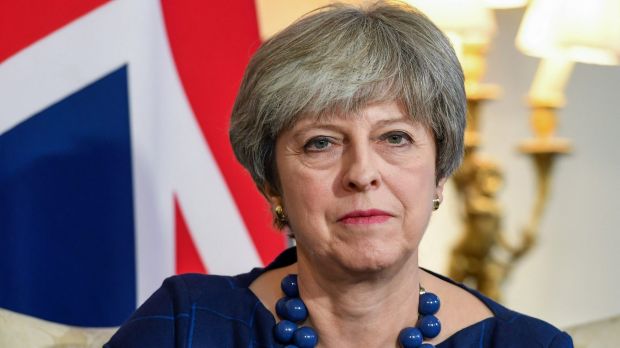
Image result for theresa mayLike Mark Twain’s death, reports of Theresa May’s demise have been greatly exaggerated. Unlike the legendary writer’s death rumours, however, these are more frequent and relentless. Quite how a person of little obvious political skill or charisma, and seemingly little personal support, has managed to soldier on in Britain’s highest political office during a period of more or less consistent crisis, will be as much a matter for political psychologists as historians in the future.

For now, it is enough to occupy ourselves with the return of that perennial British favourite, “Will Theresa Survive?” When she’s not dealing with a crisis of her own making, be it a misjudged election, a botched reshuffle, or the failure to call yet another errant minister to account, Britain’s accidental Prime Minister is usually to be found fire-fighting another round of leadership questions. Or not. The odd thing about these regular leadership issues is just how little we hear from the central figure, Mrs. May herself. Questions are asked, searing articles are penned, a sense of impending crisis is adopted, and some poor soul is shuffled in front of the cameras to make whatever limited case he or she can for the prime minister before the crisis seems to pass. The lady herself, with her pursed lips and dull, thudding phraseology, is nowhere to be seen.

Mrs. May has managed to prove the success of what is in reality a very simple political strategy. Just keep soldiering on. What is often underestimated in analyses of politicians in their insulated environment is just how little radicalism or courage they are willing to show. Caution is the best observed watchword in any political town, and no more so than in Britain’s scarcely beating political heart of Westminster. Most leaders subjected to the sort of crisis-ridden term that Theresa May has had, coupled with the relentless criticism, would have decided to either try and lance the boil with a leadership election ( a tactic once tried by John Major, which saw him re-elected but notably failed to do much lancing) or simply stand down from sheer weariness and stress. Not for nothing is Mrs. May known as the “Maybot”, a term coined by the Guardian’s political sketch writer John Crace. She really does act like some advanced form of AI which has been programmed to go through the motions of Brexit negotiations and will not be distracted from this key task by mere notions of human frailty. Only utter destruction will stop the Maybot in its tracks.

Whether such utter destruction is just round the corner is not yet fully established, but there have once again been rumblings of discontent in Westminster about her leadership. Newspapers report that the chairman of the Conservative backbenchers committee (known as the “1922” committee after the seminal moment in that year when Tory MPs ousted former war leader David Lloyd George) has received nearly enough letters from MPs to spark a leadership election. Commentators have also been dusting off their familiar critiques of the Prime Minister – that she lacks vision, is indecisive, has no idea of what she is doing vis a vis Brexit and cannot control her ministerial colleagues. And her two principal cabinet colleagues, the Foreign Secretary and the Chancellor of the Exchequer, have once again been sparring in public and producing their own versions of government policy.

There are few certainties about any of this other than that Mrs. May will never step down voluntarily, whatever the pressure. When you’ve weathered the sort of disastrous and self-inflicted election defeat that she has, and moreover proved manifestly and publicly incapable of clear leadership on the central issue facing Britain today (Brexit), and still insist on staying in office, you can guarantee nothing else is going to come along to shake that extraordinary self-belief.

The issue is less about Mrs. May now and more about her critics and putative rivals. It isn’t just caution that holds Conservatives back from igniting a leadership election whilst being in a precarious minority government. Both sides are fearful of the alternative. So-called “Remainers” see Mrs. May in all her awkwardness as palpably more acceptable than the flamboyant charlatan Boris Johnson, once again a likely prospect to triumph in a leadership election. The “hard Brexiters” meanwhile worry about the outside prospect of a Remain leader such as Home Secretary Amber Rudd or Defence Secretary Gavin Williamson. There is also the chance that they know the political damage that could well come with the sort of “hard Brexit” they are advocating, and prefer someone else to take the fall.

It is certainly conceivable that Theresa May could well still be prime minister when the Brexit deal – in whatever form – is signed and sealed in 2019. But Remainers in particular might want to consider the advantage of letting full blooded Brexiters have their day in dealing with the turbulent negotiations of the Treaty they campaigned so fulsomely for. Trying to limit the treaty, or make it look like we haven’t really left, may sound like a comforting strategy, but it will leave Remainers on the defensive and give the hard Brexiters a stick with which to beat them for many years to come. If the referendum result is to have any chance of lancing the anti-EU boil and bringing some harmony to the Tory party, it may be best to ditch Mrs. May and give Boris and his ragtag army of true believers full reign.

The post-election liberal narrative is hopelessly wrong

There seems to be a popular liberal narrative emerging about the present state of British politics which is largely summed up by (1) the Tories have got us into a mess over the past couple of years and (2) they, especially Theresa May, should apologise for getting Britain into this mess.

Utter bilge.

There may be a number of things Mrs. May needs to apologise for - a poor campaign, an overly insular leadership style, the loss of a number of Conservative seats - but all these apologies need to be directed purely at the Tory party that she leads and its candidates.  Further, an acknowledgement that she has learned lessons from the election and will seek to adapt her premiership to suit those would be helpful and politically adept.  But an apology to the country?  What a fruitless, pointless, unnecessary exercise that would be.

I presume the apology in question that liberal commentators have in mind would be along the lines of saying sorry for calling an election.  Really?  In a democracy?  The election may have been called for opportunistic and rather venal reasons, but the idea that we should somehow ration the amount of democratic engagement at the polls that the people should participate in is ludicrous and reeks of political class elitism. Mrs. May's motives in calling the election may have been ever so ignoble, but in the end she remained at the mercy of the voters.  Hubris did indeed come to rest at her door as a result, and she may wish to ponder many lessons from this, but we should not be demanding apologies from a wounded leader for the decision delivered by the people in an election.

Neither should there be an apology for calling another election in a few months if one is needed.  We are a democracy.  It is the people's right and responsibility to hire and fire their political leaders, and if that has to be done on a more regular basis until the people become satisfied with their collective decision then so be it.

There is an extraordinary feeling afoot, and it is embedded in the post-election liberal narrative, that calling elections too often is a Bad Thing.   We may be a democracy, harbouring rights that have been fought and argued for over many decades and which are still denied to the majority of people in the world, but we really shouldn't ask people to listen to political debate and hobble along to a polling booth too often.  It is the ultimate elitist nonsense, and it caters to a terrible view which suggests that we should cravenly give in to the anti-politics brigade who believe that a national political discussion shouldn't be allowed to get in the way of everyday lives to often.

This is the same view that we hear expressed about the referendum held last year which led to the Brexit process.  Now as it happens I am no fan of referendums, but I can't deny that they are the ultimate expression of the popular will on a particular issue.  It is a virtue of democracies that the popular will for change doesn't need expression in a revolution because it has a ballot box to use. 

The sub-text of much of this criticism, of course, is that the vote didn't go as liberal commentators wanted.  Rather than blame the people, however, it has become easier - though a lot more cowardly - to lay the blame at the feet of the leaders who dared engage the people in such a momentous decision.

If there is a "mess" in British politics then the responsibility lies squarely with the voters.  They have had the chance, more than they have ever had before, to direct events.  They have chosen to do so in a messy and sometimes indeterminate way.  But that is democracy, and we get the one we deserve because we are intimately involved in it.  Don't like the leaders?  Then do more than just vote.  Do more than just write well-paid columns about how bad it all is. Take some responsibility and get involved.  Stand, argue, persuade.

As it happens, I don't think the result of Thursday's election was a bad one.  It has yielded a humbled government, more willing to moderate its previously inflexible approach on Brexit, more willing to operate on a collective basis, more willing to appreciate the aims and aspirations of the voters who chose to withdraw their support.  This is what democracy should do.  The voters also, by a smidgeon, determined that they wanted the same government to continue in office.  For all his and his allies' blow-harding, Jeremy Corbyn didn't win and has no chance of forming a government with the present parliamentary make-up.  He hasn't got the numbers.  Because the voters didn't give him the numbers.  And yes, the DUP do actually count as a legitimate party.  Enough people in a part of the UK voted for them to send ten of their representatives to parliament.  They get the same rights as every other representative and that is the right, under the full scrutiny of voters who will be asked to deliver another verdict again at some point, to support or deny the biggest party its political programme.  

This isn't a "mess".  It's democracy in action and I'm sorry so many liberal commentators aren't very happy with it.  It doesn't require an apology from the prime minister.  The only people you can demand an apology from are the British electorate, and they are simply exercising the right hard won by their ancestors to nudge the government whichever way they want.  Live with it.


Lessons from an election

1.  Don't take the electorate for granted.  Theresa May's party (she abdicated the Conservative name for the duration) did this twice.  It assumed everyone would ignore the opportunistic nature of the election, and that they would then happily respond to a patronising campaign of empty slogans.  Turns out they didn't.

2.  Every vote matters, even under First Past the Post.  Young voters complained about Brexit, but their complaints carried little weight given the fact that many didn't vote in that ill conceived referendum.  This time they voted, and the change has been palpable.

3.  Traditional campaigning still matters.  Theresa May's party thought they could win this with a big data machine and by programming, without variation, key phrases into the political dialogue.  They thought they could avoid real voters with impunity, whether in televised debates or in the streets.  Jeremy Corbyn suffered a media monstering, but built up support through a consistent round of old fashioned rallies.  Crowds matter, it seems, and he was able to appeal to a decent proportion of the electorate through these rallies.  We're a democracy, and he met people.  Somehow it seems to work.

4.  Manifestos should not be insulated efforts.  Whatever the fine aims of Theresa may's manifesto, it was drawn up quickly by a tight group of May loyalists who failed to road-test it within the wider party.  It then backfired.  Surprised?

5.  Leaders should be able to campaign.  As everyone is noting, this election was entirely the product of Theresa May's desire.  There was no reason at all to call it, and certainly not the one she gave.  In consequence, though, one might have expected her to show some campaigning vigour and ability.  Alas, when calculating her election gamble, she failed to factor in her own dislike of campaigning.

6.  When you have a venerable party with all its traditions and brand, use it.  Theresa May's team confined the party name to a footnote and insisted that all of her candidates do the same on their official campaign literature.  Prospective MPs once called Conservatives simply became people "standing with Theresa May".  Once the electorate decided they had their doubts about Theresa May, there wasn't anywhere else to turn.

7.  We are a parliamentary system, not a presidential one.  See 6 above and remember that for all the dominance of party leaders, constituency candidates do still stand on their own merits as well.

8.  The "vision thing" still matters.  When all was said and done, there wasn't much of a discernible vision behind the May campaign.  "Brexit means Brexit" was as empty a slogan as has ever been uttered on a campaign trail, coming as it did with absolutely no enhancing narrative or vision at all.  Compare that with Labour's ability to appeal to a range of people with a clear vision of what needed to be done for Britain.  Agree with it or not, it gave the impression they were thinking about what to offer.

9.  Personalities are important.  Theresa May would have obviously been a dominant figure even without the quasi-presidentialism of her campaign. just as Jeremy Corbyn was on the other side.  The problem for May is that she failed to project any warmth or spontaneity and appeared to actively avoid contact with ordinary voters.  In a modern democracy it isn't possible for a leader to survive without a decent skill at communications.  May utterly lacked that.  Contrast her with the cheerful and positive Ruth Davidson, leading something of a Tory revival in Scotland.

10.  Is politics being re-set?  There is a case for this.  The election has seen the return of two-party politics, the effective icing of another Scottish independence referendum, and the likelihood of a more pragmatic, Europe friendly Brexit.  Are we coming through a nightmare period, for all the veneer of chaos that exists today?

AS Politics: Party Divisions - the Conservative Party

The problem with examining Conservative Party divisions is that we tend to still be using out of date terminology.  The party has moved on from a Thatcherite/One Nation division (if it ever really existed in one) not least because the times have changed.  No Conservative leader seriously disputes the need to maintain Thatcherism's principal legacy of a privatised economy and lower taxes (a legacy that even social democrats like Tony Blair undertook to essentially preserve).  The headline issue that split the Conservatives in the post-Thatcher years was Europe, although there was also debate around liberal versus conservative social attitudes and the extent to which public services like health and education should be submitted to the rigours of free market medicine.

The key to determining the direction of the Conservative party lies with its leaders and the best way of understanding Conservative divisions is probably via them.  Unlike its main rivals, the Conservatives are driven to an extraordinary degree by the men and women who lead it.  While Conservative grassroots members are broadly right-wing, often putting them at odds with more liberal minded leaders, they are also fundamentally loyal.  They do not have pretensions to directing the parliamentary party, even if they now expect a say in how it is led (although such a say is rare - only Iain Duncan Smith and David Cameron became leaders as a result of a grassroots vote).

Party historians date the Conservative Party back to either Robert Peel or William Pitt the Younger.  Pitt embodied the free trade philosophy that has remained part of the party's policy DNA (leading to a substantial internal divide at the beginning of the twentieth century) while Peel was an early social reformer.  Peel's cabinet included William Gladstone while his backbench MPs included Benjamin Disraeli.  Gladstone took his economic liberalism to the Liberal Party after the repeal of the Corn Laws split the party, while Disraeli eventually came to articulate what he called a One Nation vision for the Conservatives.

One Nation Conservatism - a somewhat inchoate, pragmatic blend of paternalism and specific government action to benefit the working poor in the interests of national harmony - came to dominate the Conservative Party for much of the twentieth century.  However, it was encountering problems under Edward Heath and it fell to Margaret Thatcher to provide something hitherto unknown for Conservatism - an ideology.  The liberal conservative Ian Gilmour had noted that "the wise Conservative travels light" but such lightness of travel wasn't benefiting them by the 70s, so Mrs. Thatcher brought back a form of Gladstonian liberalism in economic thought - essentially a promulgation of the virtues of the free market and private ownership - and married it with traditional Tory social conservatism.

Whilst opposed by liberal, or One Nation, Conservatives such as Gilmour on account of its negative impact upon working class communities (notably miners and traditional manufacturing workers), Thatcherism became the dominant Conservative ideology in the latter part of the 20th century.  Economic liberalism, in the form of a small state, low tax vision, was not seriously questioned although social attitudes did become a battleground between liberals and conservatives.

David Cameron became leader in 2005 and sought to modernise the Conservative brand without seriously changing its policies.  He coined the term "Big Society" for his 2010 election manifesto (an updated version of One Nation Conservatism), though in practice this amounted to little specific in terms of policy.  He also sought to focus more on 'Green" issues and social liberalism to soften the Conservative image; his embrace of gay marriage was a success for social liberals but put him at odds with a still significant socially conservative membership of his party.  He pursued some further devolution of powers away from Westminster, to a proposed "Northern Powerhouse" (the hobbyhorse of his key ally and Chancellor George Osborne) and the metro mayors elected last May - a lingering legacy.  There was also a feeling that his desire for a formal coalition with the Liberal Democrats was in part motivated by a need to have a liberal firewall against his own more right-wing back-benchers.  In government, however, he and Osborne found themselves nonetheless pursuing an austerity agenda in the light of the 2008 financial crisis that wouldn't have looked out of place under Mrs. Thatcher herself.

Like all Conservative leaders since Thatcher, Cameron was faced with a Europe problem, which he resolved by promising a referendum.  He can hardly have foreseen that this referendum would spell his own precipitate political end just a year after winning an independent majority for his party in the 2015 election.

And so we come to Theresa May.  Her speech on taking office seemed to mark the outlines of a form of One Nation Conservatism, and the 2017 Conservative manifesto - which more than many of its predecessors is the work of the leader's small coterie, notably co chief-of-staff Nick Timothy - seems to have embedded this further.  Characterised by some as "Red Toryism", May's manifesto actively promotes the idea that the state can be used to further the public good.  It talks of the "good that government can do" and rejects what it calls "the cult of selfish individualism". It wants public schools to set up state academies, promises to maintain the workers' rights that are currently embedded in EU law and even rejects the idea of ideology as "dangerous".

In her determination to use the state to protect workers and provide government oversight of businesses, May echoes some of the activist agenda of Disraeli (or more accurately his Home Secretary Richard Cross).  In identifying herself as the emblem of conservatism and thus the nation, the only person trusted to negotiate our exit from the European Union,  there are echoes of Stanley Baldwin's "Safety First" agenda in the 1930s, although they lack his sense of ease at the state of the country.

In the modern age of an expansive state, however, which has often been the target of Conservative determinations to reduce it, May has also arguably carved out a new brand of Conservatism.  One which seeks to utilise the state rather than attack it, and do so in order to widen the appeal of 21st century Conservatism to those who are not people of wealth or rank.  The so-called "just about managing" that she identified in her first speech.  Shorn of the Brexit veneer, she could be seen as the most left-wing Conservative premier yet.  This is why a High Tory like historian Andrew Roberts is so worried, as he argues in this piece, suggesting that she is not really a Tory at all. 

The Conservatives are the most pragmatic and flexible of democratic political parties.  It is one reason why they are still in business after more than two centuries.  How long lasting the May changes will be are of course dependent on the level of endorsement she gets from the electorate, and a couple of weeks before the election itself that isn't looking quite so rosy.

AS-level Politics: Party Divisions - The Labour Party

Clause One of the Labour Party's constitution commits it to maintaining a strong parliamentary party:

“[The party’s] purpose is to organise and maintain in Parliament and in the country a political Labour Party.”

Given that Jeremy Corbyn is opposed by 95% of his own MPs (only 15 MPs voted for him in the 2015 ballot; he wasn't required, as the incumbent leader, to check out that support again in 2016), the first obvious division within Labour would appear to be that between those who want to maintain a strong parliamentary party  (the MPs who opoosed Corbyn) and those who want to make it more a grassroots-run organisation (principally Corbyn supporting groups like Momentum and the Campaign for Labour Party Democracy).  This New Statesman editorial summarises and comments on the division. 

The policy differences, of course, are severe. The leaking of Labour's election manifesto suggested serious opposition within the party to it.  It has become a fundamentally binary struggle between one-time Blairite or "centrist" Labour members (the majority of the parliamentary party) and the more left-wing, nationalising tendency (Corbyn and his grassroots supporters).

The "Economist" neatly summed it up thus:

Labour is not so much an organised political party as a blood-soaked battleground between two warring factions: the far-left faction, led by Jeremy Corbyn and John McDonnell, and including acolytes such as Dianne Abbot and Emily Thornberry, and “moderate” Labour. “Moderate” Labour consists of the bulk of their MPs, including Yvette Cooper, the moderate wing’s current leader and wife of Gordon Brown’s right-hand man, Ed Balls, Stephen Kinnock, the son of the party’s former leader, Neil Kinnock and Hillary Benn, the son of the left’s former champion, Tony Benn, as well as the majority of traditional Labour voters. The Corbynistas consist of hard-left activists, many of them former members of Marxist groupuscles, who joined the party in huge numbers in the past couple of years. The manifesto is pure Corbynism. The leak is clearly an attempt by the anti-Corbyn faction to embarrass Mr Corbyn and derail his launch.

(The whole piece - from Bagehot - is worth reading).

The moderate Labour faction draws its ideological position from the recent history of New Labour, personified by Tony Blair and given shape by Peter Mandelson (and, as it happens, Gordon Brown despite his attempts to subvert it through personal opposition to Blair). More distantly, it is comparable to most previous Labour leaders such as Wilson and Gaitskell, fundamentally social democrats who believed in working effectively through parliament to gradually change Britain's economic and social institutions towards achievement of the cause of equality.  They propounded a broadly "strong", pro-US foreign policy (supporting British possession of a nuclear deterrent) with the belief in a mixed economy.  Blair's spin on this was outlined in the so-called "Third Way", a belief that Labour's brand of social democracy had to adapt to the post-Thatcher era by embracing privatisation but coupling it to the public sector (Public Private Partnerships).  He also adopted a more clearly socially liberal attitude (notably in the field of liberalising legislation on same-sex relationships).

The left-wing Labour faction of Corbyn has a new movement supporting it (Momentum) and an old one (the Campaign for Labour Party Democracy).  Somewhat ironically the CLPD is an old Bennite movement.  Tony Benn was the leader of the left in the 1980s, the last time Labour took a severe leftward turn, and his son Hillary is now one of the leading moderates in the parliamentary Labour Party, sacked as shadow Foreign Secretary by Jeremy Corbyn.  This left grouping draws its ideological position from a more radical, even revolutionary brand of socialism that despises the democratic socialism of the moderates.  They believe in a grassroots movement and a return to a state run economy, coupled with more recent cultural issues related to diversity and opposition to "country" actions like hunting and badger culling.  They also tend to embrace immigration as a positive force.

The divisions above seem straightforward enough - a classic left v right - but are muddied by the division of ordinary Labour supporters into social activists and traditional members.  The social activists who dominate Momentum are young, active on social media and committed to a range of left social causes.  The traditional Labour members are more conservative socially, oppose immigration and also tend to favour Brexit (which Corbyn, after much hesitation, supported and continues to support).  For Labour's electoral success, much depends on where these traditional members and voters decide to cast their vote, with early polling evidence suggesting that many would not vote for Corbyn.

The moderate, or social democratic, element of the Labour Party remain in a quandary.  The Labour leadership has moved far away from them, taking with it many of their constituency memberships.  There is no guarantee that Corbyn would leave the leadership if he loses (he has said that he will stay on) and should the October conference approve a further reduction in MPs' power to select future leadership candidates, they may find it impossible to restore a moderate leadership.  Which begs the question of where they go.  They are ideologically opposed to the Liberal Democrats, but the last example of moderate Labour MPs trying to form a new parliamentary grouping and national party - the Social Democratic Party of the 1980s - was ultimately a failure.

If Corbyn wins - an unlikely scenario even given the Yougov poll projecting Tory seat losses -  then moderate Labour MPs will find themselves having to support a left-wing Labour government whose policies they fundamentally disagree with, or opposing their own party in government and signing their death warrant in the constituencies.

Win or lose, Labour's existential crisis isn't going away.


Mrs. May and her flawed campaign

The Manchester atrocity hasn't actually persuaded people to forget what a very poor offering Theresa May is wanting to give them.  This is despite the serious efforts of May and her few loyalists, who have been banging on non-stop about security and doing everything they can to remind us all of Jeremy Corbyn's IRA links.  The fact is, though, that people on the doorstep are still interested in policy details that will affect them personally.

This is why the scorchingly bad social policy U-turn is still having an impact.  Tory candidates report a poor and antagonistic doorstep reaction with the U-turn itself having done little to restore any faith in Mrs. May's promises. Meanwhile the Labour party has been making more hay than expected with a range of policies that are basically saying "we know things don't work, so let's go back to a golden age of government intervention".  That works because the first part of the message resonates today and ever faulty memories allow the second part of it to gain traction.  There has been nothing particularly attractive in the offerings made by the May team, which is unfortunate because their manifesto begins with one of the best and most pronounced efforts to pitch conservatism towards the centre that has probably ever been seen in an election document.

More than part of the reason for the Tory shambles is the nature of both Mrs. May and her top team.  The lady herself is a solid but unimaginative and inflexible political performer with little depth.  She spent her Home Secretary years powering out some robust and occasionally draconian measures, toilingly defended some big mistakes and sat herself distantly from the Cameron/Osborne claque then ruling the party.  She was uninspiring but worthy; her public speeches and interviews were mundane and ultra-safe efforts, hard work to wade through and unilluminating. Fortunately for her, the more sparkling members of the political firmament all decided to implode and she was left sitting atop of the heap.  It's not the first time a worthy plodder has emerged on top and it is not necessarily a bad thing either.  However, it is not the basis for a personality campaign either.  Not in a democracy where you have to communicate outside the tribe at any rate.

Add to this the tight nature of her top team.  Just two people, her co-chiefs of staff Fiona Hill and Nick Timothy, hold any sort of power or offer any sort of advice - of the type that will actually be listened to.  This is never a good set-up, and when it is compounded by an insular defensiveness from all three of them the situation becomes worse.  And while Mr. Timothy appears by all accounts to have tried to use his position to do some genuinely blue sky thinking about Toryism, his colleague Ms. Hill seems to have spent much of her time throwing her weight around and making sure everyone knows she is in charge.  A woman who has no public accountability and has never operated in the public sphere now sends bullying or demeaning texts to elected representatives, many of whom have a deal more political experience than she does.  More fool them for taking this sort of nonsense but the overall image has been of a paranoid and narrow clique desperately preserving their power and viewing everyone outside their trio as potential enemies.

This then is the set-up that gave the Tories the cataclysmic communications failure over the social care policy (a failure for which Ms. Hill, who acquired for herself the role of communications chief once she ousted any competitors, needs to take the blame).  It gets worse though.  Calling a quick election the Conservatives resorted once again to Lynton Crosby, a man whose stock in trade is to run highly personalised and dog-whistling campaigns that seriously endanger the long-term integrity of the brand he is working for.  The abysmal Zac Goldsmith London Mayoral campaign is the stand-out example, but go back a bit further and you can unearth the Michael Howard campaign of 2005 which left many voters with a nasty aftertaste.  This time the brand isn't even Conservative.  It is firmly focused on Theresa May herself, as if a party with over two hundred years of tradition and evolving ideology has really nothing to offer.  May's halting and repetitive speech-making has made us yearn for more articulate Tory spokesmen, and reached its apogee in her car crash interview with Andrew Neill.

The Tories - and Theresa May - are still the odds-on favourites to win this election.  They may, however, be counting the cost of their victory for some years to come, especially if the centre-left ever acquire a leadership that is even marginally more competent than the Corbyn mob of hucksters.  It takes many years to build up a credible and popular political brand.  It is a brave person who can say with confidence that Conervatism will survive Brexit Mayism.


What do voters want?

The Nottingham University professor, Steven Fielding, has published two posts on the excellent university politics blog, Ballots and Bullets, dealing with the issue of what voters want - and therefore vote for - in their political leaders.

His first post was written after Theresa May appeared on the One Show.  In explaining why she would take part in a light entertainment magazine show, he noted that not only was she after its audience - some 5 million probably not very political viewers - but also needed to use the show to develop her empathy with voters.  Reasoned argument does not penetrate particularly far in a modern election, and some might dispute that two or three repeated mantras amounts to reasonable argument in any case. What voters are looking for is someone they can both admire as leaders and support as individuals who understand their own circumstances.  Fielding notes Aristotle's argument on "ethos, pathos and logos" in developing his point.

In his subsequent post, Fielding looks at the desire for voters to have a "strong and stable" leader.  Again, one might dispute whether the facts of May's leadership thus far really merit those words (weakness in the face of popular press campaigning and U-turning on budget promises within days don't constitute either strength or stability) but the reality is that she and her campaign managers have been successful in instilling that as a feature of her leadership.  Fielding references the arguments on "strong man [or person]" leadership from Plato, via Carlyle to Archie Brown (who disliked it but acknowledged the public's desire for it).

Fielding's two posts are engaging and accessible for A-level students, and help to consider what the features are for a successful leader in elections (both American and British).  They also illuminate the ongoing problem for anyone who thinks electoral politics is about an engagement of rational ideas, competing for the available political space.  It isn't and probably never has been.  It is about an engagement with the gut instinct of voters, the vast majority of whom are not interested in the minutiae of ideas.  Most voters, indeed, are not particularly exercised by the idea of democracy itself (the number of non-voters certainly indicates this, while even those who do vote contain a large number of agnostics who wouldn't miss the process if it were abolished).  What exercises them is the need for food, shelter, jobs and the chance of leisure - all exercised without obvious government presence.  If they do want to acknowledge a leader, they want that leader to look as if he or she knows what they're doing, makes occasional obeisance to the people's condition, and harasses their enemies with the minimum of actual conflict.  Currently, May understands that better than Corbyn.  Much better.

How voters think....or don't

There was a fascinating piece on the "Today" programme this morning (scroll to 1:20:35).  Listen to these voters try and identify party policies (they mostly fail), and then explain why it doesn't matter anyway.  They may or may not be a representative sample, but these ordinary voters are classic examples of the principle of voting with the gut rather than the mind.  They are happy that they don't really understand any policies, it doesn't matter what detail parties promise as "they all promise the same and never deliver".  The personality of the leader is the most important thing.

Parties spend a lot of time developing their manifestos.  Voters spend a lot of time ignoring them and then claiming the promises don't amount to a hill of beans anyway.  Win the battle of perception and you've pretty well clinched the election.  That's Lynton Crosby's key understanding, and Theresa May - neither particularly strong or particularly stable as it happens - is his most obedient pupil.  Of course she's winning.  Policies have nothing to do with it.

One friend who has been canvassing for the Lib Dems reported a voter telling him that it was important to vote for Theresa May as she needed all our support to negotiate for Brexit.  That's nonsense and it doesn't actually mean anything.  But it is the simple mantra put out regularly by May and co, and a voter who doesn't spend much time thinking about politics has swallowed it whole.

Want to be depressed about human nature?  Want to understand Thomas Hobbes a bit more?  Follow an election!


The bleak outlook for liberalism - in all parties


Labour and the Conservatives have never been particularly hospitable homes for their moderate, centrist members.  Corralled within an insulated party bubble consisting mainly of true believers, the moderate members have often been regarded as potential betrayers, consensual minded types who occasionally find common ground with their opponents; worse, as people who seem too willing to question the orthodoxies of their chosen tribe and challenge some of their heart-held beliefs.  What kept them going was the belief that their party leaderships, whatever they said in public, often shared their own centrist, outward-reaching attitudes.  In a sense they had to, for how else could they expect to govern except with the support of some of that part of the electorate which didn’t traditionally identify with their party?  So for decades in the past century or so, the two parties were, for the most part, led by mainstream centrists. 

Since 1945, the Labour party has had only one exception to this general rule until Jeremy Corbyn’s unexpected victory; Michael Foot, who presided over the disastrous defeat of 1983.  For the Conservatives, the story has been more mixed, as the era of One Nation leadership came to an abrupt halt with Margaret Thatcher’s election as leader in 1975.  Her electoral success was enabled by weak and divided opposition, but her leadership eventually became too divided for the party’s parliamentary leadership and was brutally shunted aside in favour of the more centrist John Major in 1990.  Major’s appeal brought his party an extra term in government, but his three successors ditched the appeal to moderation and presided over two election defeats until the more One Nation oriented David Cameron took over. 

Even in their darkest times – the early 80s for moderate Labourites, the noughties for moderate Tories – moderate members of each party could take solace from both the possibility of a return to favour at the top, and the knowledge that at least their opponents weren’t out and out lunatics.  A centrist Labour leadership benefited from the Tory retreat into its right-wing laager in the noughties just as David Cameron was able to see off the leftwards tilt of Ed Miliband.  Alas, no more.

If the liberal progressives in either party were tempted to be despairing about the outcome of the Brexit referendum, that is as nothing compared to the political landscape that looms before us in the 2017 general election and its aftermath.  Never has it been such a bad time to be a moderate in politics.  While Jeremy Corbyn exercises a complete control over the Labour party on behalf of his left-wing supporting movement, Momentum, Theresa May abandoned some time ago any attempt to face down her right-wing in turn.  Indeed, for all the eloquence of her chief of staff’s speech writing in the early months, it is difficult to discern a clear political vision from May, other than the need to stay in power and bludgeon a hard Brexit through parliament whatever the consequences.  There is a small remnant of moderate, independent minded MPs on the Tory benches, but they are unlikely to be much enlarged by the influx of new Tory MPs on the back of this election.

It is a bleak picture, but is there some light to be had from the direction of the Liberal Democrats?  Tim Farron has bounded fresh faced and energetic into the election and his party has trumpeted over 5,000 new members since the election was called.  They may even pick up seats – probably at the expense of Tory MPs in Remain-leaning southern metropolitan seats, or traditionally liberal south-western ones.  As nice as such a boost will be, they are unlikely to reach their glory days of 60 plus MPs without further work in the Labour strongholds of the north, and here it is more likely to be Tories – as in Copeland – who take the prize.

Why has liberalism, the progressive attitude once prevalent in all parties, reached such a dire state?

In essence liberalism has never been a far-reaching ideology in populist terms. Labour’s brand of social liberalism was smuggled onto the statute books by Roy Jenkins and his successors on the back of its more populist electoral appeal to manual Britain for better wages and working conditions, and better public services.  Margaret Thatcher’s economic liberalism came cloaked in populist attacks upon the failures of social democracy, and then appeals to national identity (via the Falklands and latterly Europe). 

Progressive liberals always sought validation from the establishment in power, and not from the people.  The belief in a reasoned, consensual, progressive building of a civilised state served by governments committed to at least some aspects of the liberal cause wasn’t one easily sold in gut electoral terms.  But populism was always tearing away at the fabric.  Most people, uninterested in politics and prepared to vote instinctively and emotively, and once upon a time tribally, had no time for the finer aspects of political debate and theorising.  While the liberal state delivered, this seemed fine, especially when each party had a core of leaders committed to variations on the same project.  Nevertheless, as turbulence swept the global community, and mass migration became a feature, the fragile belief in a liberal state that could both serve its people and extend magnanimity towards others started to explode. 

The incendiary devices for such resentment had long been readily to hand in the form of the popular press.  Once the liberal state stumbled in its attempt to explain the impact of global trends that put indigenous workers out of their jobs, and seemed to fail to arrest influxes of foreign workers to occupy the lower reaches of the salary earning spectrum, the way was open for the ever louder beat of nationalism. 

It came from the right-wing press, and was quickly adopted by politicians with an eye to the main chance.  It seems odd, in the age of social media and the generally accepted ability of anyone and everyone to forge their own news sources via facebook, blogs and twitter, to talk of the power of the press, but power it is.  Few twitter accounts or facebook pages can match the reach – even today – of traditional newspapers.  Where social media is bifurcated and diverse, newspapers still provide a common currency in news and opinion.  In some respects, social media merely amplifies this.  A single front page in the most powerful of the papers – the Mail or the Sun – can drive social media comment for days.  A largely mediocre political class remains in thrall to the apparent and high profile power of newspapers.  The Telegraph had MPs on the run for months over expenses a few years ago; Theresa May crafts her agenda almost entirely to suit the Mail and the Sun today.  And what makes these papers even more powerful is their ability to dance to the otherwise inchoate beat of the nationalist drum up and down the country.

Liberalism – the belief in reasoned, rational politics – is upended today by the resurgent triumph of nationalism.  In a shrewd column recently, the Economist’s new Bagehot (Adrian Wooldridge) identified the posthumous triumph of Enoch Powell’s vision for Britain (“Thethird man”).  The party that succeeds, he argued, would be the party that successfully articulated this ideal of a national identity, and he further noted that Theresa May’s provincially rooted Englishness seemed to have a far better chance of success than Labour’s messy, divided party. 

For the liberal, this is a most unappetising vision.  Having successfully emerged from the last wreckage of nationalist triumph in the first half of the twentieth century, securing what seemed to be a permanent supra-national and liberal dominance, the collapsing of that same hegemony, and the accompanying lack of confidence in its future, is once again unleashing the darkest of political forces.


It is a bleak time indeed to be a moderate.  

6 quick election announcement takeaways

       1.  Theresa May hasn’t actually called a general election yet.  She can’t.  The Fixed Term Parliament Act leaves that decision with the House of Commons, so in reality the fate of this putative election lies with the other parties (see Lord Norton's short sharp analysis).  If Labour – as Corbyn has asserted – supports the call, along with the SNP and the Lib Dems, then the one thing they cannot do is accuse May of putting party interest before country.  The Act no longer allows her to do that.  Instead, it makes a 2/3rds majority of MPs responsible instead.  Murmurings of turkeys and early Christmases spring to mind, and I do wonder if all Labour MPs are going to sign up to Corbyn’s suicide pact tomorrow.  If they do, then for more than a few it will be a means to hastening their unloved leader’s end.

2.       2.  Most forecasts – actually all forecasts – give the Tories a whopping likely majority.  This is pretty solid, and it will take a small political earthquake to dislodge the Tory advantage (although…Trump, anyone?).  Therefore much of the interest will be on how the opposition forces realign themselves.  If Labour really does head into an electoral meltdown, are the Liberal Democrats well placed to take advantage of it?  Tim Farron was far more sure-footed today than Jeremy Corbyn, and the Lib Dems are claiming a thousand new members in the few hours since Theresa May’s announcement.  They may also benefit from the “Remain” leaning seats currently held by Tories in south London and the south west – some estimates put their possible gains from the Tories at 27 seats.  Nevertheless, can the Lib Dems also budge Labour in its northern heartlands?  The now redundant Manchester Gorton by-election was showing some real LD strength thanks to a good local candidate, but can that be repeated across a swathe of Brexit believing Labour seats?

3.       3.  Will this election make UKIP formally redundant?  They are not defending any seats since the defection of sole MP Douglas Carswell (who was never a spiritual UKIP-er anyway)  and it will be interesting to see what happens to their 3 million 2015 votes.  If they see a sharp decline, we can probably rule them out as a political force from June 9th onwards.  If we haven’t already done so.

4.       4.  Theresa May has crafted this as an election on Brexit, but does that mean she is hoping no-one will look too closely at the rest of her domestic agenda?  She is struggling to define herself at the moment, making speeches that lean towards One Nation conservatism but carrying out actions that suggest old style Tory callousness.  Catastrophic morale in the NHS, short-funding of schools, budget incompetence recently over NI contributions, craven-ness on challenging the corporate interests she claimed to be ready to face up to….all this points to an uneasy domestic agenda that has hardly been crafted to win popular support. 

5.       5.  It’s about personalities.  With Brexit the dominant political item, and no-one really having a clue about how it will or should pan out, the election will – as so often – come down to personalities, and for May there is very little competition.  Jeremy Corbyn is as hopeless a leader as you could hope for in your opponent, while Tim Farron will struggle, even with an election megaphone, to make the impact he needs.  By slapping down the chance of a TV debate May has also deprived Farron of his possible “Cleggmania” moment.  It was a smart move on May’s part – she had nothing to gain from such a venture.

6.       6.  Finally, the result doesn’t mean a one-party state.  Should the Tories win big – the most likely outcome – they still face inordinate problems over the next five years, and such a result gives both Lib Dems and Labour the chance to properly regroup (under a new leader in Labour’s case, or with a spun off new party).  Five years may seem like a lifetime to upset liberals, but it offers May a mere two-year extension on her current lease.  In the end, that may not actually be enough if Brexit bombs.


The importance of a vanishing class: the party member

Political parties are the heart and soul of our democratic system.  They are the crucial interface between voters and professionals, providing the space for hard-pressed volunteers who may not wish to become professionally involved in politics to nonetheless become active agents in the body politic.  They have also been facing significant decline over many years.  While there has been a slight recovery in the UK since 2013 – especially for Labour and the SNP – the overall figures are depressing. 

The website Democratic Audit estimates that only 1% of the UK population is a member of a political party.  In the 1950s, parties famously calculated their members in the millions.  The Conservatives were dominant with their 3 million or so members, but Labour garnered some 1 million too. 

Labour is now the dominant party with half of their 1950s figure – 515,000 members according to a House of Commons Library briefing.  The Conservative figure is more difficult to get hold of – many of the constituency parties  don’t file complete returns, and the party still runs quite a federalist structure with significant opposition to centralising party membership.  Nevertheless, figures published in 2013 suggest the Conservatives have a mere 149,800 members.  The Lib Dems have some 79,000 members.

Party membership decline is evident across Europe, although it remains most marked in Britain.  The Democratic Party (PD) in Italy has some 500,000 members, while the two behemoths of German politics – the CDU and SPD – have around 477,000 members each.  To that figure the CDU could add those of its ally, the separate, Bavarian only CSU party which has over 146,000 members. 

Why does this matter?  Because the health of the parties is a major indicator of the health of a representative democracy.  Parties provide a key focus of engagement for citizens.  It allows them to meet with their elected representatives, have a role in choosing them, gives them a chance to offer themselves for election at local and national levels and offers a platform to change party policies. 

This is about much more than simply attaching oneself to a single cause, as offered by the pressure groups.  This is about a full and broad involvement in the democratic process.  This is about committing to action and nailing political colours to a mast – any mast. 

Parties are the foundation stones of any representative democratic system, and they depend utterly on members for both financial resources and the all important human resources.  It should come as little surprise that a growing national disengagement with politics has been accompanied by such a decline in party memberships.   Interestingly, as the memberships get smaller, the relative importance of the remaining members gets bigger.

Labour saw a spike in numbers as a result of their leadership troubles, with the Momentum movement organising effectively to get sympathisers to join and confirm Jeremy Corbyn’s leadership of the party.  Party memberships have always tended to be more radical than their outward-facing elected representatives, but as those memberships decline so the impact of a hard-core radical few makes even greater waves across the national party.  For Labour it has been the election of its most left-wing – and polling suggests unelectable – leader ever.  For the Conservatives, it gave euro-scepticism a crucial place in the party’s bloodstream and led to the Brexit referendum. 

Party memberships can absolutely define politics on the wider stage.  They can also make life difficult for specific representatives.  MPs may represent up to 100,000 people in their constituencies, but their attention can often be dragged towards the few who are members and office holders in their own party.   Labour’s MP for Brighton and Hove, Peter Kyle, faced serious de-stabilisation in September when one of his local members, briefly elected as Vice-Chairman, started agitating against him for not supporting Jeremy Corbyn.  Today, the deputy chairman of Loughborough Conservative Party went on the BBC’s “Sunday politics” to denounce his own MP, Nicky Morgan, for criticising Theresa May.  The two party office holders speak only for themselves, where Morgan and Kyle represent thousands of voters of differing hues, but that hasn’t stopped a brief but strong media focus on those party critics.

There are signs of a resurgence in the importance of party membership.  Labour’s spike – increasing its membership from 270,000 to 515,000 in less than a year thanks to the leadership election – is seen in other parties too.  The Liberal Democrats saw their membership rise significantly after their crushing General Election defeat, as liberal-minded voters sought to engage once again in a liberal fight-back, seen most recently in the success of Sarah Olney – a member of just one year’s standing – being elected as MP to the former Conservative held seat of Richmond Park.  The SNP saw a spike in membership after losing the independence referendum.  It is interestingly Conservative party membership which appears to have been least affected, even though its political bias has probably had the single most important impact on British politics in over 40 years.

As the importance of party members re-asserts itself, so elected representatives become more responsive.  The Observer’s Andrew Rawnsley notes that Labour MPs, since the re-election of their bete noir Jeremy Corbyn as leader, have been quietly re-working their constituency parties to ensure the election of supportive office-holders.   The internet supporters of Momentum have been less inclined to go the extra mile in attending local party meetings, and as Rawnsley notes, it is at these unglamorous occasions where real power can be wielded. 

The larger the membership of a party becomes, the more it can reflect the different shades of opinion in the society from which it grows, and the more effective an interface it is between ordinary voters and the professional politicians.  A larger party base, too, increases the range of talents available to parties in selecting their elected representatives, and ultimately their leaders. 


The health of a democracy, after all, plays out in the health of its parties.  

The Observer's Clarion Call for Sanity

The Observer used to be a fine campaigning newspaper, although it has become a little subsumed within its Guardian embrace in recent years.  Nevertheless, its editorial today provides the best, most vigorous response yet not only to the anti-High Court hysteria of last week, but also of the wider threat posed by a constitutionally blind right-wing movement across Europe.

In its dissection of the British constitution and its evolution, the editorial provides AS politics students with a masterly and concise overview.

In its attack on "the lie factories of Fleet Street", it offers a well executed broadside against the lethal exercise of power without responsibility that the mainstream press still has.

In its defence of the role of parliamentary sovereignty, it offers an articulate case for the virtues of that particular system.

In its linkage to the wider world of right-wing political extremism, from Donald Trump to the authoritarian clampdown of Turkey's President Erdogan, it offers a timely warning against the siren voices of the anti-liberals in our own country.

Finally, whether you agree with it or not, it offers a cogent critique of Theresa May's premiership so far - a premiership not yet affirmed by any general election result.

Today's Observer editorial is both a great campaigning piece and a well-articulated argument about our body politic that can be recommended to any reader, and certainly to the AS student in search of further, well-informed, debate.


What did the Brexiters actually want then?


It was a commonplace amongst Brexit campaigners that they wanted a return to the sovereignty of the British parliament.  They wanted British laws judged by British courts.  What they didn’t tell us was that they only wanted that if it agreed with them. 

An independent judiciary and the separation of courts and political partisanship have long been held to be the foundation stones of healthy democratic societies.  So long as courts remain above the fray then political acts can be called to account and subjected to an impartial judgement.  Politicians can too, if the need arises.  We have a strong legal system because it protects us.  We have it because we, the people, deserve that protection against the unbounded ambitions of our political leaders. 

Parliament offers up a different level of protection, but one that is no less crucial to the well-being a state’s citizens.  With proper parliamentary scrutiny, a government – the executive – cannot get away with arbitrary rule or unchecked authority, the key components of dictatorships throughout history.  It is always a dangerous sign when the leaders of an executive in a democratic society start to rail against the very institutions designed to stop their descent into arbitrary and dictatorial rule. 

It was the desire to ensure that such institutions of checking distant authority were local and robust that infused so much of the Brexit leaders’ campaigning.  One of their primary complaints against the European Union was the lack of accountability of its too distant institutions. 

The unbounded Brexit hysteria about the High Court’s ruling on Article 50 has revealed them to be little more than the populist demagogues we always suspected, rather than the guardians of a uniquely British system of calling power to account.  It is a bizarre reversal.  Their Brexit view takes on a different perspective.  Perhaps their railing against the EU was not about constitutional principle all along, but simply about the fact that they detested its political views. 

And then there is the marvellous, if wholly misleading, invocation of the “people’s will” in the Brexit criticism of the High Court.  The “people” do not act as one, and never have.  In the Brexit referendum the “people” were pretty broadly split.  Just under 17.5 million people did indeed vote to leave, but just over 16 million voted to stay.  That is a difference of less than 4%.  By no reckoning was the vote a sweeping indication of the will of all of the British people.  Nigel Farage, the defining  figure of the campaign, certainly never used to consider such a small majority to be decisive.  He claimed – before the referendum – that if only a 4% majority voted to stay in the EU, then the referendum would have to be re-run.  So the “people” cannot be invoked on the Brexiters’ side without substantial qualification.

Theresa May’s initial virtue as a new Prime Minister – one who has not of course received any mandate as leader from the British electorate – was that she understood the need to act upon the result of a referendum in which she had played only a very lukewarm role.  She was right in that.  But where she has begun to sully her reputation is in her failure to recognise that the democratic authority of the referendum was severely limited.  Limited by its tiny majority, and limited by the fact that it provided only a simple decision – to leave the EU – but left unanswered any questions about how, or even why.  Certainly the referendum provided no guidance on the mechanism of leaving.  This is where parliament correctly reasserts itself.

The UK is still a parliamentary democracy.  The occasional use of referendums doesn’t alter that.  At best, the referendums provide a direction of travel.  They do not suddenly cede a mythical popular authority to a government to do whatever it will, without recourse to parliament.  The dictators of the twentieth century favoured plebiscites as a form of underpinning for their own regimes.  Theresa May and her government are nowhere near that line, but they are favouring a similar methodology for their own purposes.


The response of the Brexit press to the High Court ruling has been rabble-rousing, inaccurate and unappealing.  It has placed the ruling as an attempt to stop Brexit rather than an attempt to restore the sort of parliamentary sovereignty that Brexiters once advocated.  It is one thing for a fickle, commercial and foreign-owned press to be irresponsible and wilfully ignorant.  It is quite another when the government in power seems to go along with it.  The Justice Secretary has revealed herself to be nothing more than a craven political hack, unworthy of the ancient duty and authority of the Lord Chancellor position which is still part of her title.  Mrs. May should be careful not to replicate the tawdry image that her Justice Secretary has acquired.  After all, she has no strong mandate herself.

Emoting about the EU


Tory MP Nick Herbert is leading the EU "Stay" campaign - or one of them at any rate - and not before time if a poll in the Mail is to be believed.  According to the Survation poll the "Leave" option now leads by 6%, given impetus it would seem, by concerns over terrorist attacks and a migrant influx that would clearly not exist if we weren't in the EU.

The Telegraph describes this as a "war", although quite why the preparation to debate an important referendum issue should be a "war" is puzzling in itself.  The Telegraph lost a lot of its news credibility some time ago when its cozy relationship with HSBC was revealed, but still.  A war?

Nick Herbert is effectively leading what will be the minority view within the Tory party about Europe.  Sceptics in the Tory party - up to and including the cabinet - are so plentiful that David Cameron has almost seemed besieged by his desire to secure a deal which could persuade people to vote to stay in.  As Nick Clegg - resurfacing on today's Marr show - remarked, it is going to be important to remember that the EU referendum extends rather further than the broiling civil war amongst the Tories.

Another salvo in the right-wing exchanges was fired in the Telegraph as well.  "Historians for Britain", a fantastically named group presumably suggesting that other historians are not at all committed to Britain, has dished the notion that the EU has had any role in preserving peace since the war.  And in this, I have to cautiously agree.  I think the EU has been a remarkable development in a continent which little over half a century ago was used to tearing itself to bits every few years on the battlefield, but yes I think NATO more than the EU can claim the credit for actually helping to preserve the very peace from which the EU has emerged and flourished.  The EU's forays into foreign policy have not been particularly effective - witness eastern Ukraine, a crisis begun at least in part by heavy handed EU overtures to pro-western Ukrainian politicians - and they struggle to speak with a single voice over such things as migration or the middle eastern conflict.  But still.  At least they do speak. And meet. And negotiate. And hold summits and things.  I doubt there's a person alive in the war-tortured middle east - outside the gun-toting, violence-inflicting, morally abandoned psycho loons of ISIS and their associates - who wouldn't rather have an EU type approach to inter-state affairs than the military machisma currently prevailing.

The referendum will hopefully be based on rational pro and anti arguments, but in amongst it I have to confess that there is a wholly emotive endorsement on my part of the whole EU experiment, and what it is meant to represent.

Will Oldham change the Labour narrative?

Until yesterday, the media narrative for the Labour party since the general election has been one of unparalleled disaster.  This only increased with the election of the very left-wing Jeremy Corbyn as Labour leader, a man whose main political work was as a serial rebel and protest march speaker.  Wholly unelectable, rejoiced the largely right-wing media in mock-sepulchral tones.  And he didn't do the things that politicians should do, like pander to the media march - this is a leader who committed the cardinal sin of failing to turn up to an Andrew Marr interview.  Honestly, where were his priorities?

Corbyn hasn't been much of a hit in the Commons, the place where the Westminster village gathers, and has rather annoyed regular Westminster watchers by taking the sting out of Prime Minister's Questions.   He doesn't even seem very interested in Westminster occasions, as if somehow they don't really impact upon his own supporters and voters in the constituencies.

Then, of course, there came the disaster of the Syrian air strikes debate - or more accurately ISIS air strikes debate (or Daesh, or IS, or whatever acronym we choose in the fond belief that they're really very interested in what we call them).  Corbyn, a man of principle even if he does look eternally miserable on television, remained opposed to strikes and wanted his parliamentary party to join him.  An undeniably inexperienced leader, he failed to properly bring his colleagues on side by largely ignoring them, and his media management remains atrocious. He gave a poor if honest speech in the debate, was eclipsed by his own shadow Foreign Secretary but helped by David Cameron's ludicrous mis-step in having spoken about terrorism's fellow travellers.

Yet while the largely hostile media revelled in Mr. Benn's fine speech (most OTT love letter was probably that of Labour refusenik Dan Hodges in the Telegraph) the voters in Oldham West were preparing to deliver a more significant verdict - that of Labour's heartland voters.

Oldham is an early test of Mr. Corbyn's electoral potency.  This may be a man who won a huge grassroots majority in his election as Labour leader, but the depreciation of his image and apparently hopeless attributes as leader have been consistently trumpeted by a hostile media.  Even yesterday, there were serious hopes that Labour would be cuckolded by UKIP in Oldham - take this piece by the Spectator's Sebastian Payne (soon to move to the FT).  Payne even visited Oldham, escaping the Westminster bubble for a day, and his finely tuned village antenna revealed these truths.  That "Corbyn's leadership appears to be dragging the party towards electoral oblivion", that there were signs on the ground that "all is not well for Labour", that UKIP's John Bickley could be the party's second MP and believes "he has struck gold with Jeremy Corbyn".  On it went.  Despite visiting Labour headquarters in Oldham young Mr. Payne still reported that UKIP could win the seat, Corbyn was a disaster on the doorstep, every time John McDonnell spoke he turned more voters towards UKIP.

But who can blame the Spectator's correspondent?  He was hardly alone in his assessment or in his Westminster assumptions that Corbyn was simply not proving up to the task, and a single visit north was not going to alter that.

Then the voters had their say.  It wasn't a big turnout, but at around 40% it was not disastrously small either.  Labour won, and won handily with a 10,000 majority.  And Labour's share of the vote actually increased.  So Jeremy Corbyn, the man who won the Labour leadership with the largest popular vote ever granted a party leader, can actually win parliamentary elections too it seems.  It's almost as if he might actually be in tune with the thinking of supporters of a left-wing party.

The vote on air strikes, too, was instructive.  While there were some headline Labour figures opposing their leader's stance, and much of the media narratvie has been about a wretchedly divided party, only 8 of Labour's 53 new MPs supported air strikes.  The vast majority agreed with Corbyn.

Labour is undoubtedly a party in turmoil.  But their new leader's key attribute is that he reaches well beyond the confines of an insular Westminster village, and the civil war on his parliamentary benches may well be more of an indication of how out of touch the more traditional, or mainstream, MPs are than any suggestion of Corbyn's own isolation.  A Corbyn led party has won a by-election that the common narrative said would be very close or potentially a disastrous loss.  He has won it well.  He keeps the loyalty of his newly elected MPs - and the majority of his shadow cabinet, and the majority of his other MPS - in a highly divisive vote.  When we next read about Jeremy Corbyn in the press, if the narrative doesn't change as a result of Oldham we should at least be highly sceptical of any stories projecting him as an inevitably election losing catastrophe.

And the Tories should sit up and take notice.  While their party gets deeper into revelations of bullying leading to suicide in their retrograde youth movement, they cannot take any comfort from the complacently driven canard that the next general election is theirs for the taking.

Lessons for Cameron from Denis Healey's "Greatness"

David Cameron could be forgiven if he enters the Tory Conference week thinking about his place in history.  This, after all, is a man who doesn’t have to win another election, since he’s given himself a final term firewall against any future electoral catastrophes.  Not only that, but he’s been able to witness Big Bad Jezza Corbyn’s utter catastrophe of a party conference over the past week, with possibly only a few hours off to mull over the deteriorating quality of western foreign policy (currently sub-contracted out to the country formerly known as the Soviet Union).

Corbyn is a delight in many ways.  He’s not quite as different as a party leader as some hopefuls are suggesting, admittedly.  George Lansbury and Michael Foot were also bizarre lefty true-believers with a lofty disdain for practical politics, and both proved electorally disastrous for the Labour party, albeit from a better intellectual vantage point than the fuzzy minded Corbyn.  But Corbyn is the first of that mould to appear in the age of constant media, and his disdain for the “media commentariat”, coupled with his notoriously badly structured, dull black holes of speeches have all gone to contribute to the carefully spun image of a man who is “authentic”. 

Corbyn’s conference was a sheer joy for David Cameron.  The Labour leader’s select-a-policy style, and his refusal – or inability – to have his shadow cabinet speaking from anything like a single song-sheet, must all be making the current leasee of No. 10 Downing Street giddy with the prospects of his future greatness.  And Cameron has to think about his future greatness as he has no more general elections to win.

What he does have, though, is a referendum to win and if he is to finally rest on the front bench of Great Tory Leaders (Andrew Roberts examines the competition in this piece for the Spectator this week) he will need to ensure that he persuades the country – and much of his own party – to stay in Europe.  Whatever the Euro-sceptics say, Cameron doesn’t see leaving Europe as much of a triumph for his avowedly internationalist approach.

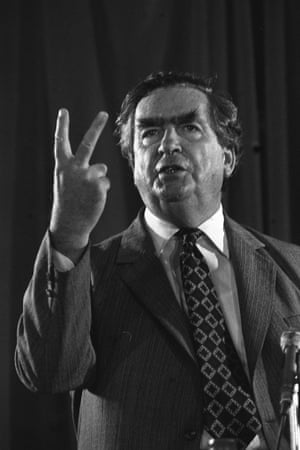
Musing on possible future greatness might have led Cameron to read more carefully the obituaries of Denis Healey this weekend.  Whether great or not – there is plenty of scope for debate – Healey was one of the best known politicians of his era.  He was an early example of the “celebrity” politician who could probably be recognised by the average don’t-care-about-politics-they’re-all-liars voter in the street.  Bushy eyebrows may have helped, and the fact that he was thus easily caricatured by the greatest performing impressionist of his day, Mike Yarwood, but Healey was also well known because he was trenchant.  He rarely expressed modest views and wasn’t shy about condemning his opponents.  His reference to Geoffrey Howe having all the savagery of a dead sheep in his parliamentary attacks has been well recorded.  Less often noted, and more scathing, was his outraged condemnation of Margaret Thatcher as a prime minister who “gloried in slaughter” during the Falklands War.

The problem for Denis Healey – who has received universally positive obituaries – is that his greatest achievement was born out of disaster.  As Labour Chancellor of the Exchequer during the awful 70s he had to advise a recalcitrant party that the days of ambitious spending were over.  He began – in the teeth of massive Labour opposition – a sharp programme of austerity.  It was forced upon him by the fact that he was the first – and to date the only – Chancellor to ask for a loan from the IMF to tide the tanking British economy over. 

I doubt that, when he entered politics after a heroic military career during World War II, Healey envisaged his claim to greatness resting on such a terrible reversal of fortunes.  He spent the rest of his active political career trying to persuade the Labour lefties of the need for responsible policies and a need to appeal to centrist voters.  He failed in this. 

Perhaps that is the lesson from Denis Healey’s career.   Cameron can muse that even if the worst happens, and the country votes to come out of the Union he thinks we should maintain membership of, if he should live long enough afterwards even his failure might be perversely turned into some sort of triumph.

Was it a bad campaign, or are we bad voters?

It's the anniversary of the defeat of Germany in 1945 today.  Many have said that the western countries were fighting to preserve liberty and democracy.  At least in part.  So it might be worth considering the state of the democracy that today's anniversary kept in being.

As commentators use up the last of their "what sort of coalition are we likely to have" scenarios, they've turned to the "what a dreadful campaign it's been" ones.  This has been most eloquently - and perhaps lengthily - illustrated by Michael Deacon's piece in today's Telegraph, but he is not alone.

It's a moot point as to how seriously we should take the journalistic moaning of stagnant campaigns.  Politicians are where they are, and do what they do, largely as a consequence of the way our brave journo have covered previous campaigns, and cover politicians generally.  Douglas Murray has identified this aspect of the state of our democracy most clearly in this piece for the Spectator.

He notes, first, that:

Of course the result is aggravating, in part because we keep trying to enjoy contradictory things. For instance at some point in recent years it was decided that any statement outside a vague centre-left orthodoxy constituted a ‘gaffe’. Such ‘gaffes’ get highlighted by the media who then seek denunciations of the ‘gaffe’ from any member of the public. The result is that politicians now treat words like landmines and try to speak only in the bland language of political orthodoxy. We are obviously not entirely happy with this arrangement because at the same time as having created this type of politics we complain that our politicians are all similar, dull identikit figures.
Or take the striking reluctance of the major party leaders to meet any ordinary voters. There was a time, not long ago, when even a Prime Minister could get up on a stage at election time, address an audience and take the risk that the audience might include doubters, hecklers and even political opponents. But then the cameras began to flock to anyone who challenged the politicians and presented them not as one person with an opinion, but as the authentic voice of the people and a possible game-changer in an election. After several rounds of this, the parties clearly recognised that the negatives associated with meeting the general public vastly outweighed any positives. This isn’t so much the case for the small parties, who have less to lose, but for the main parties, meeting just one angry member of the public can now derail a whole campaign.
And he goes on:

Whose fault is this? Well it is the media’s of course. But it is also the fault of us, the public, for pushing politicians away even as we complain that they are ignoring us. In the same way that it is our fault for wishing for impossible things from our leaders while giving them a pass for failing at possible things.

There is a great deal more in his article, one of the must-reads for anyone wondering how we have got where we are today.  But today of all days, when we get to exercise our right to freely choose the men and women who will represent us and form our government, in a process that we've kept not least because of sacrifices made in a war which concluded 70 years ago, we might like to ask whether there are any, rather smaller, sacrifices we ourselves could make to ensure its health.


Designed with by Way2themes | Distributed by Blogspot Themes