September 2015 Sea Surface Warmest On Record

Arctic Sea Ice Extent Growth Seals Off Arctic Ocean


Arctic sea ice increased rapidly in October 2015, after reaching its annual minimum in September. As the image below shows, the growing sea ice extent has effectively sealed off the Arctic Ocean from the atmosphere, resulting in less evaporation and heat transfer from the ocean to the atmosphere.

The Naval Research Laboratory 30-days animation (up to October 22, with forecast added up to October 30) on the right shows that sea ice has grown in extent, adding plenty of very thin sea ice, while the existing ice has hardly increased its thickness.

The Buffer Has Gone

Thick sea ice used to extend meters below the sea surface in the Arctic, where it could consume massive amounts of ocean heat through melting this ice into water. As such, thick sea ice acted as a buffer. Over the years, Arctic sea ice thickness has declined most dramatically. This means that the buffer that used to consume massive amounts of ocean heat carried by sea currents into the Arctic Ocean, has now largely gone.

Latent heat loss, feedback #14 on the Feedbacks page
Cold Freshwater Lid on North Atlantic

Meanwhile, especially from 2012, huge amounts of freshwater have run off Greenland, with the accumulated freshwater now covering a huge part of the North Atlantic, acting as a lid that prevents ocean heat to evaporate from the North Atlantic.


Since it's freshwater that is now covering a large part of the surface of the North Atlantic, it will not easily sink in the very salty water that was already there. The water in the North Atlantic was very salty due to the high evaporation, which was in turn due to high temperatures and strong winds and currents. Freshwater tends to stay on top of more salty water, even though the temperature of the freshwater is low, which makes this water more dense. The result of this stratification is less evaporation in the North Atlantic, and less transfer of ocean heat to the atmosphere, and thus lower air temperatures than would have been the case without this colder surface water.

Cold freshwater lid on North Atlantic, feedback #28 on the Feedbacks page
The cold lid over the North Atlantic has meanwhile expanded. Greenland has been experiencing wild weather swings this month, with temperatures shifting from one extreme end of the scale to the other end. The image below shows temperature anomalies on October 17 (left panel), October 23 (center panel) and a forecast for October 30 (right panel). Temperatures are forecast to swing back to the extreme high end of the scale, pushing up temperature anomalies for the Arctic as a whole to as high as 2.37°C on October 30, 2015.

Wild weather swings causing methane releases, feedback #21 on the Feedbacks page
These wild weather swings over Greenland threaten to cause cracks in the ice, with methane hydrates in the ice becoming destabilized, resulting in releases of huge amounts of methane from hydrates and free gas into the atmosphere, as earlier discussed as feedback #21 on the Feedbacks page.

Strong winds have further contributed to extend the cold lid over the North Atlantic, while also making cold air flow from Greenland over the North Atlantic. This is illustrated by the image below, depicting the situation on October 23, 2015, with the left panel showing surface wind speed, while the right panel shows the resulting sea surface temperature anomalies. 


The video below shows surface wind speed forecasts in the Arctic from October 25 to November 1, 2015.


Ocean Temperature Rise

NOAA analysis shows that the global sea surface in September 2015 was the warmest on record, at 0.81°C (1.46°F) above the 20th century average of 16.2°C (61.1°F). On the Northern Hemisphere, the anomaly was 1.07°C (1.93°F).

[ click on image to enlarge ]
Of all the excess heat resulting from people's emissions, 93.4% goes into oceans. Accordingly, the temperature of oceans has risen substantially over the years and - without action - the situation only looks set to get worse.

The Threat

As ocean temperatures continue to rise, especially in the North Atlantic, the Gulf Stream will keep carrying ever warmer water from the North Atlantic into the Arctic Ocean. Without the buffer of thick sea ice to consume the increasing amount of ocean heat, the threat is that ocean heat will increasingly reach the seafloor and unleash huge methane eruptions from destabilizing clathrates. Such large methane eruptions will then warm the atmosphere at first in hotspots over the Arctic and eventually around the globe, while also causing huge temperature swings and extreme weather events, contributing to increasing depletion of fresh water and food supply, as further illustrated by the image below, from an earlier post.
[ click on image at original post to enlarge ]

October 2015 Sea Surface Temperature Update

The North Atlantic continues to be very warm. Sea surface temperature anomalies were as high as 7.9°C or 14.2°F at a location off the east coast of North America on October 22, 2015. Anomalies were 8.1°C or 14.5°F at that same spot on October 16, 2015.


Sea surface temperature anomalies were as high as 7.5°C or 13.6°F at a location near Svalbard on October 25, 2015. On October 9, 2015, sea surface temperatures were as high as 13.1°C or 55.6°F at that same location near Svalbard (marked by green circle on image below), an anomaly of 9.5°C or 17.2°F. These temperatures indicate that the water can be much warmer below the surface than at the surface, and that this warm water is transported by the Gulf Stream below the surface of the North Atlantic into the Arctic Ocean. The animation below switches between the above two dates and also shows that the cold freshwater lid on the North Atlantic has meanwhile extended further south.


In the Bering Strait, warm water also keeps flowing into the Arctic Ocean. At the location marked by the green circle on the image below, sea surface temperatures were as high as 7.3°C or 45.1°F on October 22, 2015, an anomaly of 5.7°C or 10.2°F.


Methane

The images below show high methane concentrations over the Arctic.


Above image shows methane levels at low altitude on October 22, 2015. Because of its height, there are no data at this altitude for Greenland. The image below shows methane concentrations at a higher altitude, with high methane levels showing up over Greenland on October 16, 2015.


Climate Plan

The situation is dire and calls for comprehensive and effective action, as discussed at the Climate Plan.

Malcolm Light comments

GLOBAL EXTINCTION IS NOW SIX YEARS CLOSER

The following comments refer to Figure 224 below. All historical floating ice appears to have been lost in the Arctic by September 2015 so we can assume that the 5+ year old ice pack has largely gone by this time. The 5+ year old ice pack was only predicted to melt back by 2021.7 consequently this year's volume of ice melting has occurred 6 years earlier than the previous prediction. The previous estimate of the final loss of 1 year Arctic floating ice from polynomial data was 2037.7 which now corrects to 2031.7, 16 years in the future.

Previous estimates of when the average atmospheric global temperature anomaly increase would reach 6°C was 2034.7, by which time massive global extinction would be proceeding. The new corrected time for this event is 2034.7 - 6 = 2028.7 which is 13 years in the future. During the major Permian Extinction event, which was caused by a massive methane build-up in the atmosphere, the mean surface atmospheric temperature increased by 5°C over 13 years. As the present mean global surface atmospheric temperature is already greater than 1°C hotter than the mean, we will be looking at at least a 6°C temperature increase by 2028 with its associated global extinction event. This is a frightening correlation between the new predicted 6°C average global surface atmospheric temperature rise and what is known to have occurred during the major Permian extinction event, both of which were caused by a massive buildup of methane in the atmosphere. We are clearly in for a very rough-hot ride in the next decade as the terminal global extinction event approaches.

Malcolm P.R. Light (Dr)
Earth Scientist
Figure 224. Arctic sea ice melt back times estimated from area, volume and thickness anomalies compared to various extinction zones defined by the global atmosphere temperature field. Credit: Malcolm Light. Click on image to enlarge.

Related

- Ocean Temperature Rise
http://arctic-news.blogspot.com/2014/10/ocean-temperature-rise.html

- Ocean Temperature Rise Continues

- Gulf Stream brings ever warmer water into Arctic Ocean
http://arctic-news.blogspot.com/2015/06/gulf-stream-brings-ever-warmer-water-into-arctic-ocean.html

- The Mechanism leading to Collapse of Civilization and Runaway Global Warming
http://arctic-news.blogspot.com/p/the-mechanism.html

- The Threat of Global Warming causing Near-Term Human Extinction
http://arctic-news.blogspot.com/p/threat.html

- Warming Arctic Ocean Seafloor Threatens To Cause Huge Methane Eruptions
http://arctic-news.blogspot.com/2015/09/warming-arctic-ocean-seafloor-threatens-to-cause-huge-methane-eruptions.html

- Climate Plan
http://arctic-news.blogspot.com/p/plan.html


NOAA analysis shows that the global sea surface in September 2015 was the warmest on record, at 0.81°C (1.46°F) above...
Posted by Sam Carana on Friday, October 23, 2015

Lucy-Alamo Projects - Hydroxyl Generation and Atmospheric Methane Destruction

As you know the weather is starting to change rapidly for the worse now and I have been working on Arctic methane induced global warming for about 14 years. There are massive deposits of methane gas trapped in the undersea permafrosts in Russian waters and onland in Siberia as well and if the global warming boils of just 10% of what is there, there is enough to cause a Permian style extinction event that humanity will not survive. Some brilliant work on the Arctic methane threat has been done by a Russian scientist Natalia Shakhova and others who indicate that we are in a very perilous position, if we don't find a way of reducing the atmospheric methane and depressurizing the undersea methane to stop the massive methane eruptions there. I and some other workers have designed a radio-laser Atmospheric methane destruction system based on the early Russian radio-wave induced conversion of methane to nano-diamonds. This radio-laser system can be installed on nuclear powered boats such as the 40 Russian Arctic ice breakers and start immediate work on destroying the atmospheric methane clouds that are building up in the Arctic. An abstract about the system is attached and it has been accepted for presentation at a congress of the American Meteorological Society to be held on January 10 - 14, 2016 at New Orleans in Louisiana, U.S.A. This system should be mounted on the nuclear icebreakers and used onshore. Once the methane is brought under control there should be a reduction in the massive fire hazards, heat waves and severe storms systems that are plaguing Russia and the rest of the world.

Yours sincerely,

Malcolm P.R. Light
Earth Scientist

The Abstract follows:-
No. 275345 Lucy - Alamo Projects - Hydroxyl Generation and Atmospheric Methane Destruction.
by
Malcolm P.R. Light (Dr)
Retired, Cortegana, Spain

Congress of the American Meteorological Society, Wednesday 13, January, 2016

Methane formed by organisms in the water becomes trapped in the fabric of water ice crystals when it freezes and is stable below about 300 metres depth in the Arctic Ocean and on the shallow East Siberian Arctic Shelf. There are such massive methane reserves below the Arctic Ocean floor, that they represent 100 times the amount, that is required to cause a Permian style major extinction event, should the subsea Arctic methane be released into the atmosphere because of methane's giant global warming potential (100 to 1000 times CO2) over a short time period (Light and Solana, 2012 - 2014, Carana 2012 - 2014). There are also giant reservoirs of mantle methane, originally sealed in by shallow methane hydrate plugs in fractures cutting the Arctic seafloor and onshore in N. Siberia (Light, 2014, Carana 2013, Light, Hensel and Carana, 2015). The whole northern hemisphere is now covered by a thickening atmospheric methane global warming veil from Arctic methane emissions at the level of the jet streams, which is spreading southwards at about 1 km a day and already totally envelopes the United States (Figure 1). There must therefore be a world-wide effort to capture and thus depressurise the methane in the subsea and surface Arctic permafrost and eradicate the quantities accumulating in the ocean and atmosphere.

Methane produced at the surface diffuses upward and is broken down by photo dissociation (sunlight) and chemical attack by nascent oxygen and hydroxyl (Heicklen, 1967). The Lucy Project is a radio/laser system for destroying the first hydrogen bond in atmospheric methane when it forms dangerously thick global warming clouds over the Arctic (Figure 2, Light & Carana, 2012). It generates similar gas products to those normally produced by the natural destruction of methane in the atmosphere over some 15 to 20 years. Radio frequencies are used in generating nano-diamonds from methane gas in commercial applications over the entire pressure range of the atmosphere up to 50 km altitude (Figure 2, Light and Carana, 2012). Recent experiments have shown that when a test tube of seawater was illuminated by a polarized 13.56 MHZ radio beam, that flammable gases (nascent hydrogen and hydroxyls) were released at the top of the tube (iopscience.iop.org, 2013). In the Arctic Ocean, polarized 13.56 MHZ radio waves will decompose atmospheric humidity, mist, fog, ocean spray and the surface of the waves themselves into nascent hydrogen and hydroxyl over the region where a massive methane torch (plume) is entering the atmosphere, so that the additional hydroxyl produced will react with the rising methane, breaking a large part of it down (Figure 2)(iopscience.iop.org, 2013).

A better system could use Nd: glass heating lasers containing hexagonal neodymium which is stable below 863oC (Krupke 1986 in Lide and Frederickse, 1995). Neodymium glass lasers have extreme output parameters with peak powers near 10 to the power 14 watts when collimated and peak power densities of 10 to the power 18 watts per square cm if focused (Krupke 1986 in Lide and Frederickse, 1995). Velard (2006) states that at the Lawrence Livermore Laboratory, for inertial confinement nuclear fusion, "192 beams of Nd: glass - plate amplifier chains are being used in parallel clusters to generate very high energy (10 kilojoules) at a very high power (>10 power 12 watts) and at the second and third harmonics of the fundamental, with flexible pulse shapes and with sophisticated spectral and spacial on - target laser light qualities". The Nd: glass laser system is more stable and efficient than the longer wavelength CO lasers and shorter wavelength KrF lasers (Velard, 2006).

The three 13.56 MHZ radio transmitters in the Lucy Project (Figure 2) could be replaced by 3 groups of parallel lasers each forming a giant circular flash lamp. Half the Nd: glass lasers in the flash lamp could be tuned to exactly 21 million times the 13.56 MHZ methane destruction/nano-diamond formation frequency (Mitura, 1976). The adjacent alternate lasers will be tuned to a slightly different frequency exactly out of phase with the primary frequency by 13.56 MHZ.The Nd: glass lasers have a wavelength of 1052 nm equivalent to a frequency of 2.85*10 power 8 MHZ. The methane molecule requires 435 kilo-joules per mole to dislodge the first hydrogen proton and an average of 409.3 kilo - joules per mole for the other three protons (Hutchinson, 2014). Hydroxyl requires 493 kilo - joules per mole to generate it from water (Hutchinson, 2014). A set of four focused Nd; glass lasers will have an energy of about 454.5 kilo-joules per mole, and will be strong enough to dislodge the first hydrogen proton from a methane molecule. Of course this can also be achieved by increasing the number of focused lasers to six or eight. Exactly the same neodymium laser system could be shone on the sea surface, at the base of the rising methane cloud, generating hydroxyls and nascent oxygen and thus breaking down the methane. The power source for these radio transmitters/lasers in the Arctic can come from floating or coastal nuclear or gas electric power stations and the transmitters could be located on shore or on boats, submarines, oil-rigs and aircraft. We have only 1 to 5 years to get an efficient methane destruction radio-laser system designed, tested and installed (Lucy and Alamo (HAARP) projects) before the accelerating methane eruptions take us into uncontrollable runaway global warming. Humanity will then be looking at catastrophic storm systems, a fast rate of sea level rise and coastal zone flooding with its disastrous effects on world populations and global stability.


Links


- Lucy-Alamo Projects - Hydroxyl Generation and Atmospheric Methane Destruction, by Malcolm P.R. Light (Dr) Light
https://ams.confex.com/ams/96Annual/webprogram/Paper275345.html

- North Siberian Arctic Permafrost Methane Eruption Vents, by Malcolm P.R. Light, Harold H. Hensel and Sam Carana 

- Poster created for Geophysical Congress on methane hydrates, earthquakes and global warming, Nice, France, 2002, by Malcolm Light and Carmen Solana
http://arctic-news.blogspot.com/p/seismic-activity.html


Poster Presentation at American Meteorological Society's 18th Conference on Atmospheric Chemistry, January 10 - 14,...
Posted by Sam Carana on Monday, October 19, 2015

It's a Wild Ride

It's 4:49 a.m. My alarm goes off and I hop off of the couch, where I have been sitting and reading. I wash my breakfast dishes, grab my lunch and use the bathroom one last time and then I put on my helmet and grab my bike and my backpack and walk out the door.

It's about 2 miles from my house to the train station. Luckily, in the morning, it's mostly downhill. I put on my bike light, hike up one leg of my pants and start pedaling. You never know what you are going to see on the streets of Oakland at 5 a.m. There are not too many cars, which is good because that means I can buzz through most of the intersections without slowing down too much. There are sometimes people, but they are mostly like me, heading to work in the dark of the night.

Except for one corner which is near the train station. This corner is a bit different that the others. Women hang around in short skirts; men in trucks slow to a crawl as they pass. It's usually pretty quiet though; I pedal through with no problems.

I reach the train station in about 7 minutes. I constantly try to break the 7 minute time and have only done it once. It all depends on how I hit the traffic lights and how many cars there are that I have to avoid. I get there around 5:07, lock up my bike and hop on the train to work.

In the afternoon, the same journey takes about 12 minutes. From the station, I have to ride uphill and generally its around 4 or 5 pm. I have to stop at every intersection, sometimes for 2 or 3 minutes. There are cars to avoid, as well as people, broken glass, a lone shoe and a condom. It's hot and the traffic is busy and I swerve around old ladies and kids on skateboards. It's a whole different world. I can see everything.

I get home, hop off my bike and push it into my living room, where it lives. I do everything in reverse: walk in the door, backpack off, helmet off, put my lunch in the sink and use the bathroom one more time.

Note: I have been commuting by bike to the train station for a few months now and am really loving the view I am getting of the world this way. Plus a little extra exercise using different muscles never hurts!

How do you get to work? Do you ever walk or ride a bike? What interesting things have you seen while cycling? 

Arctic Sea Ice 2015 - update 11

Arctic sea ice extent has been growing rapidly recently. The image below shows extent up to October 9, 2015 (marked by red dot).


Below is a comparison of sea ice thickness as on October 6, for the years (from left to right) 2012, 2013, 2014 and 2015. The comparison shows that decline has been strongest where sea ice used to be the thickest, i.e. over 3 meters thick.


One of the reasons why the thickest Arctic sea ice has declined so dramatically over the years is the rising ocean heat that is melting the sea ice from underneath. The image below illustrates the situation on October 5, 2015, when sea surface temperature anomalies were as high as 6.4°C, 7.4°C and 7.3°C (11.5°F 13.2°F and 13.1°F) off the North American coast, and as high as 9.4°C (16.8°F) near Svalbard.


Water temperatures are very high in the Arctic, as further illustrated by the image below showing Arctic sea surface temperature anomalies as at October 9, 2015.


Rising ocean heat is further illustrated by the graph below, showing August sea surface temperature anomalies on the Northern Hemisphere over the years.
The situation is very dangerous, due to feedbacks and their interaction. The thicker sea ice used to act as a buffer, consuming ocean heat in the melting process. Without thicker sea ice, ocean heat threatens to melt the sea ice from below right up to the surface, causing the entire sea ice to collapse. As the sea ice declines, more open water will give rise to stronger winds and waves.

Furthermore, sunlight that was previously reflected back into space will instead be absorbed by the water, causing rapid rise of the temperature of the water. In places such as the East Siberian Arctic Shelf, the water is on a average only 50 m deep, so warmer water is able to reach the seafloor more easily there. As ocean heat keeps rising, there's a growing risk that heat will reach the Arctic Ocean seafloor and destabilize methane hydrates in sediments at the Arctic Ocean seafloor.

The image below shows a non-linear trend that is contained in the temperature data that NASA has gathered over the years, as described in an earlier post. A polynomial trendline points at global temperature anomalies of over 4°C by 2060. Even worse, a polynomial trend for the Arctic shows temperature anomalies of over 4°C by 2020, 6°C by 2030 and 15°C by 2050, threatening to cause major feedbacks to kick in, including albedo changes and methane releases that will trigger runaway global warming that looks set to eventually catch up with accelerated warming in the Arctic and result in global temperature anomalies of 16°C by 2052.

[ click on image to enlarge ]
The situation is dire and calls for comprehensive and effective action, as discussed at the Climate Plan.

Comparison of sea ice thickness on October 6, for the years (from left to right) 2012, 2013, 2014 and 2015, shows that...

Posted by Sam Carana on Saturday, October 10, 2015

Lessons for Cameron from Denis Healey's "Greatness"

David Cameron could be forgiven if he enters the Tory Conference week thinking about his place in history.  This, after all, is a man who doesn’t have to win another election, since he’s given himself a final term firewall against any future electoral catastrophes.  Not only that, but he’s been able to witness Big Bad Jezza Corbyn’s utter catastrophe of a party conference over the past week, with possibly only a few hours off to mull over the deteriorating quality of western foreign policy (currently sub-contracted out to the country formerly known as the Soviet Union).

Corbyn is a delight in many ways.  He’s not quite as different as a party leader as some hopefuls are suggesting, admittedly.  George Lansbury and Michael Foot were also bizarre lefty true-believers with a lofty disdain for practical politics, and both proved electorally disastrous for the Labour party, albeit from a better intellectual vantage point than the fuzzy minded Corbyn.  But Corbyn is the first of that mould to appear in the age of constant media, and his disdain for the “media commentariat”, coupled with his notoriously badly structured, dull black holes of speeches have all gone to contribute to the carefully spun image of a man who is “authentic”. 

Corbyn’s conference was a sheer joy for David Cameron.  The Labour leader’s select-a-policy style, and his refusal – or inability – to have his shadow cabinet speaking from anything like a single song-sheet, must all be making the current leasee of No. 10 Downing Street giddy with the prospects of his future greatness.  And Cameron has to think about his future greatness as he has no more general elections to win.

What he does have, though, is a referendum to win and if he is to finally rest on the front bench of Great Tory Leaders (Andrew Roberts examines the competition in this piece for the Spectator this week) he will need to ensure that he persuades the country – and much of his own party – to stay in Europe.  Whatever the Euro-sceptics say, Cameron doesn’t see leaving Europe as much of a triumph for his avowedly internationalist approach.

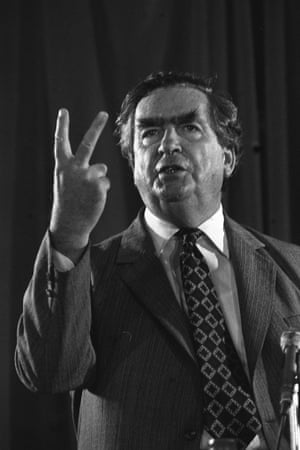
Musing on possible future greatness might have led Cameron to read more carefully the obituaries of Denis Healey this weekend.  Whether great or not – there is plenty of scope for debate – Healey was one of the best known politicians of his era.  He was an early example of the “celebrity” politician who could probably be recognised by the average don’t-care-about-politics-they’re-all-liars voter in the street.  Bushy eyebrows may have helped, and the fact that he was thus easily caricatured by the greatest performing impressionist of his day, Mike Yarwood, but Healey was also well known because he was trenchant.  He rarely expressed modest views and wasn’t shy about condemning his opponents.  His reference to Geoffrey Howe having all the savagery of a dead sheep in his parliamentary attacks has been well recorded.  Less often noted, and more scathing, was his outraged condemnation of Margaret Thatcher as a prime minister who “gloried in slaughter” during the Falklands War.

The problem for Denis Healey – who has received universally positive obituaries – is that his greatest achievement was born out of disaster.  As Labour Chancellor of the Exchequer during the awful 70s he had to advise a recalcitrant party that the days of ambitious spending were over.  He began – in the teeth of massive Labour opposition – a sharp programme of austerity.  It was forced upon him by the fact that he was the first – and to date the only – Chancellor to ask for a loan from the IMF to tide the tanking British economy over. 

I doubt that, when he entered politics after a heroic military career during World War II, Healey envisaged his claim to greatness resting on such a terrible reversal of fortunes.  He spent the rest of his active political career trying to persuade the Labour lefties of the need for responsible policies and a need to appeal to centrist voters.  He failed in this. 

Perhaps that is the lesson from Denis Healey’s career.   Cameron can muse that even if the worst happens, and the country votes to come out of the Union he thinks we should maintain membership of, if he should live long enough afterwards even his failure might be perversely turned into some sort of triumph.

Cyclones continue to hit Northern Hemisphere

As the 2015 El Niño gets stronger, the Northern Hemisphere continues to get hit by strong winds and cyclones. The image below shows strong winds over the Arctic Ocean, as hurricane Joaquin approaches the coast of North America.


On above image, hurricane Joaquin is clocked at a speed of 79 mph (127 km/h) on October 1, 2015. NOAA warned that on that day the maximum sustained wind speed had increased to near 120 mph (195 km/h) with higher gusts.

For reference, NOAA uses four categories:
D: Tropical Depression – wind speed less than 39 mph (63 km/h)
S: Tropical Storm – wind speed between 39 mph and 73 mph (63 km/h - 118 km/h)
H: Hurricane – wind speed between 74 mph and 110 mph (118 km/h - 177 km/h)
M: Major Hurricane – wind speed greater than 110 mph (over 177 km/h)

NOAA issued the image below on September 30, 2015, warning that Hurricane Joaquin is likely to cause wind damage across a large part of the eastern coast of North America.


The NOAA animation below gives an idea of the strength of hurricane Joaquin.

[ click on image to enlarge, note that this is a 1.4 MB file that may take some time to fully load ]

Meanwhile, sea surface temperatures off the North American coast, as well as in the Arctic Ocean, are very high, as illustrated with the image on the right.

In the Arctic Ocean, the sea ice in many places is now less thick than it was in 2012, as illustrated by the image further below, showing sea ice thickness on October 7, 2012 (panel left) and a forecast for October 7, 2015 (panel right).

The water in the Arctic Ocean was already very warm this year. The main factor causing both these strong winds and the dramatic decrease in thickness of the multi-year sea ice is ocean heat, as also illustrated by the image below, showing high sea surface temperature anomalies in the Arctic as at September 30, 2015.


As the image below shows, nearly all the thick (over 3 m) multi-year sea ice has now disappeared, setting up a dangerous situation for the future that is much more dangerous than the situation was back in 2012. The thicker sea ice used to act as a buffer, consuming ocean heat in the melting process. Without thicker sea ice, ocean heat threatens to melt the sea ice from below right up to the surface, causing the entire sea ice to collapse as more open water will go hand in hand with stronger winds and waves. In case of such a collapse, sunlight that was previously reflected back into space will instead be absorbed by the water, causing rapid rise of the temperature of the water. In places such as the East Siberian Arctic Shelf, the water is on a average only 50 m deep, so warmer water is able to reach the seafloor more easily there.


The water of the Arctic Ocean is very warm, not only at the surface, but even more so underneath the surface. The danger is that strong winds will mix warm water all the way down to the seafloor, where it could destabilize sediments that can contain huge amounts of methane in the form of hydrates and free gas.

[ click on image to enlarge ]
The image on the right illustrates the impact of winds over the East Siberian Arctic Shelf on September 26, 2015.

NSIDC specialist Julienne Stroeve recently warned"In 2007 more than 3m of bottom melt was recorded by [an] ice mass balance buoy in the region, which was primarily attributed to earlier development of open water that allowed for warming of the ocean mixed layer. But perhaps some of this is also a result of ocean mixing."

As discussed in an earlier post, sea surface anomalies of over 5°C were recorded in August 2007 in the Arctic Ocean. Strong polynya activity caused more summertime open water in the Laptev Sea, in turn causing more vertical mixing of the water column during storms in late 2007 and bottom water temperatures on the mid-shelf increased by more than 3 degrees Celsius compared to the long-term mean.

The situation is dire and calls for comprehensive and effective action, as discussed at the Climate Plan.


As the 2015 El Niño gets stronger, the Northern Hemisphere continues to get hit by strong winds and cyclones. The image...
Posted by Sam Carana on Thursday, October 1, 2015

Looking Back: September

September! Back to school days and leaf raking days; new pencils and old friend days; putting on pants and jelly making days. Early sunset nights and late sunrise days. Soup days and boot days. Crisp air and fog days.... What does September mean to you?

Running: I clocked just over 100 miles this month, which is better than last month! However, I did not get the same amount of hiking in, so the total "time on feet" was less. Instead, I have been focusing more on my strength training, and am doing a twice a week strength training regime rather than so much running. This month's totals were 45 miles of hiking, 53 miles of biking and 9 strength training sessions.

Reading: This was a good reading month quantity-wise, but only so/so quality-wise. I ended up reading 9 books and two half books (couldn't finish/had to put down)! My favorites were these four:

Farewell to the East End: The Last Days of the East End Midwives
Americanah
Station Eleven
This is the Story of a Happy Marriage

Travel: My vacation spanned two separate months, so September marked the end of my trip to Europe. The first week of the month included a relaxing soak in a thermal bath, some hiking in the Alps of Switzerland, more cheese and bread and wine, and a trip to see a very old friend of mine, who had been an exchange student in my tiny high school when I was growing up. She lives near Geneva and so I not only got to see her house and to meet her husband and children, but I also traveled with her to her parents house in the mountains, where I got to meet the whole family, hike in the snow and drink Schnapps. It was a fun time all around!

Swiss cows are friendly!

After I returned, I spent a bit of Hobbit time doing things around the house, visiting local friends, going out for drinks with the work mates, cooking, shopping and eating and generally just catching up on life. I still have a mountain of items on my To Do list, but I am checking them off little by little! Unfortunately, new ones keep popping up!

And....Beer: New category! You know how you try things, such as beer, or wine or a new recipe, and then when you go to get another or make another, you can't remember the name or the website? Well, to prevent that, I am trying to remember to log things better and to write them down. So, the new beer I tried in September that I liked was: Fieldwork's Torrential Double IPA (website here).

What do you have on your To Do List? What new beer have you tried lately? What happened in your September worth mentioning? 
Designed with by Way2themes | Distributed by Blogspot Themes