Showing posts with label General election 2015. Show all posts

Those who can, organise; those who can't, commentate

Lynton Crosby is certainly entitled to a bit of triumphalism.  Getting Boris to London City Hall is one thing, but getting David Cameron back to Downing Street with a majority against all the odds certainly ranks as one of the great Lazarus tricks of modern politics.  So well done Mr. Crosby.  If you weren't already in the super-league of international political consultants, I guess you must be not only in it but near the top of it now.

He's left us with a bit of a gift too.  Not a big speaker to the press (no good campaign manager wants to be the story during a campaign, as Alastair Campbell should have realised) he has now given a departing interview to the Daily Telegraph.  Amongst all the post-election ink flow, this one provides some of the more interesting and controversial analyses, coming as it does from the man who won.

As I read his interview, I warmed to the man, far more than I might have expected.  It was two points in particular that produced that feeling of positivity towards an undoubted political rottweiler of the right.  First, apropos of a more significant point, he quoted that well worn canard that "Those who can do, those who can't teach".  I sighed internally for a brief instinctive moment as I read that one.  No teacher in this country has gone through their lives without having that one quoted incessantly at them by hilarious friends heading off to their long lunches in the city, or gobby students who have just been told off for yet another tedious infraction.  But my sigh quickly turned to a gasp of surprise.  Crosby was quoting this to do it down.  His wife, it turns out, was a teacher and "I don't really agree with that" he said.   Well, well.  Here was a human side I hadn't realised before.  And a possible explanation for one of his earliest influences on the Conservatives' election campaign - the removal of toxic Michael Gove from the Department of Education to the hidden (until the fiasco of the attempt to unseat the Speaker) realms of Chief Whip.

But the second reason for warming to Mr. Crosby was his second, more significant point.  He claims that it is not only pollsters who should be hanging their heads for failing to misread the nation.  He has a very vigorous, and heartfelt it seems, pop at the world of the political commentariat.  He adapts his teacher comment for the world of politics to read "Those who can do, those who can't commentate."  It was a feeling I'd had myself.  Not, I hastily add, the insight that the commentators had it all wrong.  That was a Crosbian intuition based on extensive internal polling.  My feeling was an increasing level of irritation at the apparently all knowingness of commentators who hadn't stepped out of the metropolitan bubble.  I blogged about it here, getting particularly irate at the desire of the commentators to keep knocking the campaign for its dullness instead of perhaps trying to enagage a little more deeply with the actual issues.  Andrew Marr was an annoying example of one who praised the wonderful brilliance of the commentariat but thought the actual campaign being waged by, you know, actual politicians on the ground, was just "tooth-grindingly awful".

Well, Crosby has launched his mighty artillery at them, and is firing a shot in defence of those who have bothered to participate.  The street pounders, canvassers, representatives and their agents, all seeking to do something a bit more than carp from the sidelines.

We need good commentators.  At their best they provide a much needed guide to the often treacherous paths of political discourse.  Divorced from the need to please an electorate they can bring some objective perceptions that illuminate the world that should so fascinate all of us.  But Crosby rightly condemns those who seem to see politics more as entertainment.  Better paid than many of the ordinaries whose vote is the warp and weft of the active politicians' work and voice, they have become too comfortable in their carping sanctimony.  I don't agree with his picking out of Tim Montgomerie necessarily, who has after all been engaged with the political world of both policy and voters rather more directly than many writers, but I do laud his broader principle.

We get the politics we deserve, but very often it is the media not the politicians themselves who too often frame our polity.  Yes, they should start taking some responsibility for that.


The hell keeps on coming for Labour

There was an outpouring of Blairite angst over the Miliband election campaign last week, but the hell isn't over yet for the "Hell, yeah" leader.  Today's "Times" sees political columnist Philip Collins provide one of the most seering condemnations of the Miliband experiment that I've read.  It makes Peter Mandelson sound like Bagpuss.

Collins' first targets are the "cavalry of denial" who are lining up to contest the Labour leadership, so Yvette Cooper and Andy Burnham.  Noting that Labour's electoral problem was as significant in England as in the much reported Scotland, he describes Yvette Cooper's recent article for the "Mirror" as "a platitudinous, intern-drafted press release for the Pontefract and Castleford Express", taking her to task for the blithe belief that the average voter really liked a lot of what Labour was saying.  Er, no they didn't, notes Collins.

On to Andy Burnham, whom he beautifully stilletos for being "close to tears about how much he loves the NHS" during the election campaign, and goes on to lambast for his belief that millions of people need to have an "emotional connection" with the Labour Party.  Responds Collins, "Normal people, in the normal world, have emotional attachments to their families not the Labour Party".  On Burnham's leadership bid, the columnist says that "I don't mind that Mr Burnham is Len McCluskey's candidate but it really worries me that he might be George Osborne's". (There is, by the way, a fantastically vituperative several lines aimed at McCluskey's wretched impact on the Labour Party concluding "belt up and leave the politics to people who know what they're doing.")

But it is Ed Miliband for whom Philip Collins reserves his most scathing ire.  Noting that Mr. Miliband shows little sign of acknowledging that his whole election strategy might have been wrong, based as it was on a misguided belief that the country had somehow moved, or could be persuaded to move, sharp left, Collins takes the former leader to task for his vain and misguided campiagn.  Suggesting that the Miliband strategy was to speak only to the 2% of the rich and 8% of the poor, but not to the unsqueezed middle in between, he writes:

"The Labour party in 2015 became the victim of a ghastly atavistic dispute, the lab rat for Mr Miliband's experiment in proving that his father, who insisted there was no parliamentary road to socialism, was right all along."

It is a tour de force of an article, well worth the price of today's "Times" (it is behind a paywall online, but cough up for a copy; if we don't pay for our journalism we'll end up with only having uninformed free stuff and that's no future for comment or reportage).  Andy Burnham is overdue for a bit of well placed lambasting.  A ghastly, over-emotional head in the sand denier of even his own previous record as Health Secretary, he must indeed be the preferred choice of the Tory Party for next Labour leader.  He's good for another few constituency defections in five years time if anybody is.  But Miliband too, in his absolute conviction that he was the right leader for Labour, a conviction that took him to fratricide and then to five years of sheer bloody torture for his party as they tried to convince themselves that he would come good in the end, is overdue for a bit of effective dousing.

Collins suggests that there could be optimism for the Labour party if they bother to heed the lines of the re-awakened Blairites and go for a next generation leader like Umunna, Kendall or Hunt.  He's almost certainly right.  If the Tories are worried that the next five years will watch them slowly unravel and expose their fractious tensions to the electorate, they will be praying that Len McCluskey remains the most influential player in the choice of the next Labour leader.  

Was it a bad campaign, or are we bad voters?

It's the anniversary of the defeat of Germany in 1945 today.  Many have said that the western countries were fighting to preserve liberty and democracy.  At least in part.  So it might be worth considering the state of the democracy that today's anniversary kept in being.

As commentators use up the last of their "what sort of coalition are we likely to have" scenarios, they've turned to the "what a dreadful campaign it's been" ones.  This has been most eloquently - and perhaps lengthily - illustrated by Michael Deacon's piece in today's Telegraph, but he is not alone.

It's a moot point as to how seriously we should take the journalistic moaning of stagnant campaigns.  Politicians are where they are, and do what they do, largely as a consequence of the way our brave journo have covered previous campaigns, and cover politicians generally.  Douglas Murray has identified this aspect of the state of our democracy most clearly in this piece for the Spectator.

He notes, first, that:

Of course the result is aggravating, in part because we keep trying to enjoy contradictory things. For instance at some point in recent years it was decided that any statement outside a vague centre-left orthodoxy constituted a ‘gaffe’. Such ‘gaffes’ get highlighted by the media who then seek denunciations of the ‘gaffe’ from any member of the public. The result is that politicians now treat words like landmines and try to speak only in the bland language of political orthodoxy. We are obviously not entirely happy with this arrangement because at the same time as having created this type of politics we complain that our politicians are all similar, dull identikit figures.
Or take the striking reluctance of the major party leaders to meet any ordinary voters. There was a time, not long ago, when even a Prime Minister could get up on a stage at election time, address an audience and take the risk that the audience might include doubters, hecklers and even political opponents. But then the cameras began to flock to anyone who challenged the politicians and presented them not as one person with an opinion, but as the authentic voice of the people and a possible game-changer in an election. After several rounds of this, the parties clearly recognised that the negatives associated with meeting the general public vastly outweighed any positives. This isn’t so much the case for the small parties, who have less to lose, but for the main parties, meeting just one angry member of the public can now derail a whole campaign.
And he goes on:

Whose fault is this? Well it is the media’s of course. But it is also the fault of us, the public, for pushing politicians away even as we complain that they are ignoring us. In the same way that it is our fault for wishing for impossible things from our leaders while giving them a pass for failing at possible things.

There is a great deal more in his article, one of the must-reads for anyone wondering how we have got where we are today.  But today of all days, when we get to exercise our right to freely choose the men and women who will represent us and form our government, in a process that we've kept not least because of sacrifices made in a war which concluded 70 years ago, we might like to ask whether there are any, rather smaller, sacrifices we ourselves could make to ensure its health.


An Unusual Election - three defining characteristics

Three things mark this election as unusual. 

One is the remarkable paucity of actual policy debate.  Yes, there’s been some to and fro on housing, a modicum of difference on tax generation, but outside of the narrow-cast debate on the economy very little of substance has been thriving. 

Defence?  Michael Fallon wants us to fear the SNP’s bid to get rid of Trident, but offers little in the form of positive defence policy for himself.  Foreign Affairs?  Ed Miliband briefly attended to an area that has never been an interest of his to accuse David Cameron of responsibility for migrant deaths.  But foreign affairs spokesmen have been so low-key as to be rendered unpersons, barely able to stop the traffic in their own constituencies, never mind the rest of the globe around which they potter so un-noticed.    Education?  Once hugely controversial, with Michael Gove’s disappearance from the issue it has sunk into the backwaters of little regarded speeches and rarely referenced manifesto promises that vary imperceptibly.  What about Health?  Well, yes, it’s a big issue, and that one has received coverage, but only in the “we all want more health care but aren’t sure how to pay for it” sense.  Welfare has just hit the headlines because Danny Alexander wants to fire the smoking gun of Tory plans to cut it drastically.  Otherwise, everyone has been keen to keep their plans under wraps.

There has been some notion that this has been a much more localised election instead, although such localisation often extends little further than objections to new housing plans and a desire for more health provision (as was the case in a true blue constituency I was recently canvassing in).

Two is the impending indecisiveness of the final result.  If this election produces the second hung parliament in a row, it will have dealt a decisive blow to the idea that our favoured First Past the Post system of voting essentially secures single-party governments (misleadingly also often seen as “strong”).  Since this has long been one of the main reasons for continuing to uphold a manifestly disproportionate electoral system, it may be reasonable to question what the other virtues of FPTP might be, especially if the other consequence of it materialises – the forming of a government by the second placed party in terms of vote share and possibly seats.   Like the Scottish referendum, the AV one may also be up for re-issue sooner than we could have imagined.

Mention of Scotland brings us, of course, to the third characteristic of this election.   The role of the Scottish National Party, and the future of Scotland itself, has played  a larger part than ever before.  For the first time in over a century, a block of MPs from one part of the United Kingdom have the opportunity to significantly influence the agenda of the rest of the UK in their favour.  Like the Irish Nationalist politicians before them, no-one doubts that, whatever Nicola Sturgeon may be saying for election purposes, the aim of the SNP block in the House of Commons will be to ultimately secure independence for Scotland.  It is true that the party’s extraordinary success this time round has arisen in part from the failure of the three UK-wide parties to maintain the engagement of the Scots in the mundane routine of legislation.  It is also true that the once dominant Labour Party has neglected its fiefdom too much and finally sent it revolting – the failing of one-party systems the world over.  But it is the issue of devolution which has really spurred the SNP rise, keeping the issue of Union firmly on the Scottish agenda despite the rejection of independence last year.

Nonetheless, the eventual impact of the SNP has been exaggerated.  They may become the third largest party in the Commons, but their actual ability to sway the agenda there is far more limited than the campaign paranoia has suggested.  George Eaton makes the point well in the New Statesman.  Nicola Sturgeon’s absolute refusal to countenance a Conservative government has in reality limited her room for manoeuvre with respect to a Labour one.  She cannot act against a Labour government without incurring the significant wrath of those of her supporters who take her anti-Tory commitments at face value.  Ed Miliband has actually got a pretty free space for action without SNP interference.

For all the Scottish noise and fury though, it is still England which is at the heart and centre of the election, and it is English issues – some institutional and long-term – which have moulded its course. England remains an ultra-centralised country which does not have its own dedicated government.  It is a country where localism fails to engender any local support, but scepticism towards the centre also remains endemic.  To have a good understanding of England today requires a strong sense of the country’s history and evolution.  Robert Tombs, the author of the sort of brilliant, sympathetic and perceptive study that England is not often fortunate enough to have, has produced a wonderful distillation of some of the key aspects of England’s past that shed light on our current election.  It is an article that bears further comment, but for now I urge you to read it at the New Statesman’s site.


How the three characteristics above play out after May 7this part of the fascination of the present contest.  We may know the allocation of seats on May 8th., but I suspect we will still be some way off knowing which party, and which leader, is going to be able to take us through the next few, constitutionally turbulent, years. 

The Union Under Threat?

The devolution referendum proved a hollow victory in the end for unionists.  Losing the campaign for hearts and minds, the southern party leaders came up with an extraordinary pledge that stretched the idea of union to breaking point.  It also added something into the referendum mix that wasn't actually on the ballot at all.  No-one can say whether or not the final result really was a vote for the Union, or in actuality a vote for the devo-max that English leaders were offering by the end.  Then, as soon as the vote was passed, David Cameron, the quintessentially English leader with the very Scottish name, sought immediate political advantage by demanding English Votes for English Laws.  He has also been happy to put himself forward in this election campaign as an English, rather than British, leader.

Well, the SNP advance in Scotland continues apace it seems, such that polls today suggest they could sweep the board and take all of Scotland's 59 MPs.  What has so signally failed with the Union, we should be asking here in England, that the Scots have turned so wholly towards its nationalist party.  And this despite the distinctly chequered record of that same party in the Scottish government.

Is the Union under threat?  It would certainly be foolish to imagine that it is safe and cosy.  The Spectator's Scottish editor, Alex Massie, has been writing regularly and forcefully about English and Conservative indifference to Scotland, and his piece today strikes an even harder note.  It is quite probable that while the election comes up with an ambivalent result in England and Wales, it produces a very clear result in Scotland.  A result that says the Union as we know it is over.


Election Notes 2 - Brand, Legitimacy and a Defence Fail

Brand meets Miliband....or Vice Versa

Difficult to know who was the most important of the two in yesterday's Miliband versus Brand meeting, but it's certainly caused waves and who knows, that might be what Ed Miliband really wanted.  after all, he was never going to get an intelligible political debate from Russell Brand.

Miliband has been making more, and more interesting, waves this election than David Cameron, and that should worry the Tories.  He has taken them - and his own party - by surprise with a pretty good campaign so far, and while some of his moments have been awful ("Hell, yes" springs to mind), on the whole he's trumped expectations pretty niftily.  That should at any rate be a warning to the Tories who keep insisting on employing negative campaigner Lynton Crosby - do someone down too much and you'll find they merely have to walk unaided to appear triumphant.

Inevitably, the two camps on the Brand interview are the right-wing one, broadly following David Cameron's effective line that Brand may be funny, but the election is not a joke (some might dispute the first part of that statement), and the liberal "Brand has something to say" camp, praising Miliband for reaching to young voters via the Brand network.  Interestingly, the ever wordy Hugo Rifkind of the Spectator is in the latter camp here, while the other newspaper views can be seen here.


Legitimacy

The question of whether a prime minister is legitimate if his party is only second is dealt with effectively by prominent politics academic Philip Cowley here.  He reiterates the nature of our system - its the numbers, and that means seats - in a column that should be read by anyone remotely interested in a quick road-check of how our constitution actually works when it comes to passing laws in parliament.


Defence Fail

Defence Secretary Michael Fallon has had a pretty awful election, coming up with fear stories about Trident and the SNP effect.  It didn't get any better for him last night with his Daily Politics debate, as the Spectator's Isabel Hardman comments, although she does try and suggest he is simply following someone else's line on this (Lynton Crosby, are you there?)

The Tories used to be pretty solidly the party of defence.  This election they're keeping quiet about it for the most part, knowing that they can't and won't guarantee the 2% of GDP they want other NATO countries to spend on it, and virtually conceding defence as an issue to anyone else who will take it.   It's a shambolic position, entirely in line with what has been an increasingly patched up foreign policy approach all round that is beginning to leave Britain marginalsied.  Voting Conservative for Britain's strong place in the world is not a line anyone could take without a smirk these days.

The Tories' constitutional malice

The Conservative party used to be one of rectitude and respect for the constitution.  No longer, if its tactics in this election are anything to go by.  Take its approach to Scotland and the issue of parliamentary legitimacy.

Dave's SNP Card

David Cameron's attempt to corral votes by raising the spectre of SNP power at Westminster is a pretty negative tactic, and of course will do nothing to endear Scottish voters to the Tory party in Scotland one suspects, but it may be paying dividends.  Albeit on the margins.  A poll in the Independent reports that the prospect of a Labour-SNP deal is indeed off-putting to a number of voters - one in four is the number cited. This has not yet, of course, translated into actual votes, or even definite determinations to vote Tory.  The main polls still suggest the Tories are struggling to keep much of a lead, although yesterday's Ashcroft poll showed a 6-point lead for them, the largest yet.

The problem with Cameron's SNP tactic is that it threatens the very Union he believes in, by suggesting it is wrong for Scottish voters to have an impact on Westminster decision making.  It also seeks to exploit English nationalism, a dangerous approach which will be difficult, or impossible, to reverse.

It might have been more effective to try and undermine the SNP on the basis of their policies and their own rule in Scotland.  When Eddie Mair interviewed SNP MP Angus Robertson on PM last week, he had him blustering when challenging him on the failure of the SNP government to reduce A and E waiting times.

There is also a peculiarity in the steamroller impact that the SNP is having in Scotland.  This avowedly independence oriented party is winning all before it in a nation which voted against independence by a margin of 10%.  It is surprising, to say the least, that unionism has not yet managed to find a ready challenge, perhaps via tactical voting.  This is a graphic sign of the failure of the major parties in Scotland, especially the once dominant Labour party.  If the election result forces all of them to review their strategy in Scotland it will be one worthwhile result.

Legitimacy?

The issue of whether it would be legitimate for Ed Miliband to take office as PM even if he comes second in vote share or seats is still haunting the election.  Theresa May - unworthily - raised it, and a Newsnight ComRes poll suggested that it was something that voters increasingly feel is a post-election issue.  It isn't, and the poll exhibits a general non-understanding of the British constitution amongst voters, but when senior politicians are willing to play around with such nonsense it is hardly surprising that it might gain traction.

The Tories are not, in sum, doing themselves much justice when it comes to constitutional issues.  David Cameron uses scare tactics to gain English support at the expense of the Scottish support his party has recently found it so difficult to pursue.  His Home Secretary produces wilfully wrong-headed and malicious interpretations of basic constitutional assumptions.  If they do return to government, it will be as a severely reduced party in terms of its constitutional integrity, and that serves no-one well.

Belated Boris Comment!

When students in Year 10 (14 and 15 years old, for those unfamiliar with our education staging system) ask you whether you've seen the Boris interview, you know that this politician is still a cut above the others.  There aren't many who could draw the interest of teenagers, but Boris is still there, making waves.  The Tories' famous politician "who reaches the parts others can't reach", yadda, yadda, yadda.

But this most recent interview was something of a disaster for him, and a success for the relaxed and humorous Labour leader Ed Miliband.  Who'd have thought - Ed just needed to sit on a sofa with Boris in order to look good.


The virtue of Boris is that he does indeed have a wide appeal as an individual, though not one that necessarily lifts his party.  He has also suggested that his politics might actually be a little broader, One Nation based even, than the average Tory politico.  The problem of Boris is that he doesn't really do detail, or precision, or seriousness.  All of this was in evidence in the Marr interview.  Imagine if this had been a meeting of two party leaders.  There's Ed Miliband, confident of his policy detail, relaxed enough to have a few pops at Boris about his and the Tory party's strategy chief Lynton Crosby.  And there's Boris Johnson, still using bluster to get his way through an interview, looking bemused when challenged on policy detail.

Not all of the critics of Boris' interview are as clearly opposed to his politics as this pretty fair-minded piece by politics.co.uk's Adam Bienkov.  But if sympathetic critics think that Sunday's Marr interview was a bit of  a car crash, they should remember that it wasn't the first.  Boris' integrity was well and truly skewered by Eddie Mair when he stood in for Marr once.  Mair was unimpressed by Boris' joker status - something Marr consistently tries to play to - and as a result produced one of the most lethal interviews the London Mayor has done.  There's a long way to go yet before he becomes Tory leader.


Cameron - not as good a phony as Blair?

David Cameron has discovered passion, ten days before the election.  It does, admittedly, come a day after a couple of big-time Tory donors criticised the Prime Minister for being lacklustre and uninspired.  As such, Mr. Cameron's passion has been treated rather cynically by the hacks, as this run-down of tweets indicates.  One of the Tory donors in question has now rather degradingly withdrawn all of his criticism and described himself as a "nobody" but Cameron's attempt to inject passion still seems redolent of what Spectator columnist Isabel Hardman calls his "essay crisis" style of leadership.

The problem is that Mr. Cameron is no great actor, and his pumped-up performance, containing such gems as the revelation that he feels "bloody lively" about the election, really doesn't convince.  He has managed to enter Ed Miliband's equally cringe-worthy "Hell, yes" territory and in straying away from his actual persona he risks the same level of ridicule.  Perhaps in such a close election, with no-one being able to identify the election grail, we should be a little forgiving of politicians under pressure, and that would include Mr. Cameron's football "brain fade" as well.

Cameron recently implied he was a West Ham fan (perhaps a little influenced by the fact that his small business ambassador and letter-writing supporter, Karren Brady, is currently vice-chairman of the club).  This is at odds with his earlier stated support for Aston Villa, which itself was at odds with his one-time expression of utter disinterest in football at all.  The fact is, rather like his "bloody lively" attitude, Cameron's football fan pitch doesn't really convince.  In this, as in much else, he appears to be following the lead of that other public-school educated fan of the working man's game, Tony Blair.  Blair, though, was a far more accomplished phony, as this illuminating and rather contemptuous article from the Economist suggests.

Perhaps we should be pleased that Cameron is not a very good phony, but it would be even better if he just felt comfortable showing us the real him.  He's not too difficult to discover, and his interview in this week's Economist gets rather closer to understanding his essentially pragmatic approach to governing than his pumped-up stump speech.

Election Notes 1

Ten days to go, and it seems time to update this blog accordingly.  It's not that I've been disinterested in this election - on the contrary, it is fascinating, especially given the uncertain outcome - but time doesn't so far seem to have permitted.

Polls, Polls

There have been more polls than ever before in this election, and for all the slim differences between them they are all pointing to no overall majority for either main party.  Hence, of course, all the chatter about whom might deal with whom on May 8th onwards.  You can take your pick of the various conglomerate polls being issued on a daily basis.  The UK Polling Report comes from a Yougov expert; May2015, the special election site set up by the New Statesman, provides exhaustive polling commentary; and three university academics update their election forecast regularly too.  But the BBC and pretty well all of the press feature regular poll tracking.  In the end, this is a parlour game for observers like us, and once May 8th comes around all of the polls that have been keeping us entertained and fascinated in the election period are reduced to utter irrelevance.

The Forecast - Who Will be PM?

So we can probably guess either Cameron or Miliband, barring a sudden change in party leader to facilitate better coalition deals, but which one of them eventually governs from No 10 is virtually impossible to predict, and may still be a mystery several days beyond the election.  Given the likely outlay of votes for their own parties, the next PM will have to be the one who is most likely to garner a workable coalition, and it has to be said that Ed Miliband does look a more likely bet than David Cameron.  The problem for Cameron is that there is only one party he can realistically do a deal with, and that will be the much reduced Lib Dems.  Even that opiton is hardly a certainty.  For all the success of the Coalition, a large group of Tory MPs have been consistently chafing against it and might be expected to try and torpedo any future arrangement.  From the Lib Dem side, many of their activists have been similarly put off any more coalitions, especially given the look of their own reduced circumstances in parliament as a result.  Add to this the uncertainty of Nick Clegg's return to the Commons, or that of the only other feasible Lib Dem leader who would favour coalition with the Tories, Danny Alexander, and even the Lib Dem option doesn't look particularly good for Cameron. A Tim Farron leadership, for example, would be much more susceptible to Labour's wooing.  Cameron's best chance of governing is obviously to achieve a majority, but present polling evidence suggests this is well nigh impossible.

Ed Miliband, conversely, has a number of options to consider.  As well as the Lib Dems, he can rely on some acquiescence from the SNP, however much he may try and puncture the idea pre-election.  Any Green or Plaid Cymru MPs might similarly be inclined to give a Miliband government a working chance, as would Northern Ireland's SDLP MPs.  The May 2015 site considers the options in a detailed look at likely seat outcomes here.  Dan Hodges in the Telegraph takes issue with their reasoning here.

A Question of Legitimacy

British prime ministers have rarely encountered problems of legitimacy, but the tightness of this race, and the prospect of a second placed Ed Miliband taking office has certainly produced some debate about whether a leader who is placed second in both votes and seats would be legitimate.  The New Statesman's George Eaton considers the dilemma here, while the Guardian's Jonathan Freedland seeks to challenge the narrative of legitimacy here.  On the BBC site, meanwhile, James Landale offers up several scenarios on legitimacy.  The most conicse, and most robust, response, however, is probably that stated by Dan Hodges.  He says simply (and accurately):

The rules of our political system are clear. We were offered a chance to change them in 2011, and we politely declined. All that matters is the parliamentary arithmetic. If Ed Miliband has enough votes to win a confidence motion, and David Cameron does not, Ed Miliband is prime minister. No caveats. No debates. No “battles over legitimacy”. If Miliband wins, he wins.


When Toryism moves right....

Lynton Crosby's general campaign advice for the right-wing politicians he expensively manages generally seems to be to tack right, and then right again, until you've out-manouevred anyone else who might be coming from that direction.  It seemed to work in Australia for John Howard.  It didn't work for Michael Howard in Britain in 2005.  And the jury is obviously out on its impact on David Cameron's campaign in 2015.

Mind you, there used to be a time when the Conservative Party didn't see tacking right as a useful or honourable tactic.  This was a party that held a variety of centre-right views together - including, yes, some of the 'ultras' - but believed firmly in its national position as a "One Nation" party, needing to look beyond its own borders for support and affirmation.  It was a party that understood the welfare state, tapped in to the aspirations of lower income earners whilst maintaining their safety net, and vigorously challenged any onset of incipient racism that might come up, especially under the guise of "immigration reform". To his credit, one of Michael Howard's finest blasts came in his searing attack on the BNP.  It was always a great shame that this fundamentally decent man allowed his campaign to be defined by posters of the inflammatory nature as the "Are you thinking what we're thinking?" kind.  If you want an inkling of what this Tory Party used to sound like, give Michael Heseltine's piece in today's Mail a read.  It is a full and wholesome put-down of Nigel Farage's race-meddling and brooks no thought of dealing with such a man, likening him to a less intelligent version of Enoch Powell, another politician at ease with the far right.

The vigour of the Heseltine attack on Mr Farage is all the more satisfying for the weak-minded, feeble appraoch shown by the Conservative Party's actual leader, David Cameron.  He seems to have embraced the Crosby mantra of not annoying UKIP supporters, and as such has successfully conveyed - yet again - an image of flaccid, unprincipled, short-termist leadership.

If you want a sharp and unforgiving assessment of the Cameron mode of leadership, read Nick Cohen in the Observer.  I know Cohen is no conservative, but he is a clear-headed commentator on politics who gives no quarter in his honest assessments of both right and left.  His condemnations of Cameron are given greater force because they ring so true.  He compares his approach to that of Angela Merkel, who denounced the anti-Muslim protestors in Dresden in no uncertain terms as having "prejudice, hatred and coldness in their hearts".  Try listening for anything even remotely similar from Cameron about UKIP and you'll end up getting your ears tested.

Cohen also - rightly - mocks the Tory choice of candidate to challenge Nigel Farage in South Thanet as an attempt to simply provide Faragism without Farage.  Might as well have thrown in their lot with Farage from the word go.

If the modern Tory Party really can't attack a man who openly plays with racist ideas, no matter how cunningly phrased, then it does need to start asking why it is even in business.  Time used to be that we knew what broad-mindedness differentiated the Tory Party from fringe right-wing groups.  It looks as if that time is no more, and the UK is the loser.


As the parties sectionalise their appeal, is British politics fracturing?

This far out from a long-planned general election, you can understand why political commentators are becoming desperate for any sort of hook on which to hang yet another election-related article, and why such articles are increasingly speculative.  Everyone suspects the next election will yield results which are some way transformative.  There will be more smaller party representation perhaps.  Another coalition is on the cards maybe.  A party representing the national interest of one part of the UK will have a stranglehold over the other two parts we're told.  All of which may be true, but not until May can we speak of these things with any degree of certainty.  Hence the apocalyptic speculation that is currently the norm amongst commentators.

Nonetheless, the search for new angles can produce some interesting assessment of the current British political condition, and two notable commentators - James Forsyth from the right and Andrew Rawnsley from the left - have produced this Sunday's best conjectures.

Both, through different arguments, are essentially noting the fracturing of the British political scene into areas of geographic or sectional interest.  Forsyth, in the Spectator (summarised here on the Coffee House blog) considers the notion that the main parties are no longer properly national ones.  This is in large part because they are now so uncompetitive in different parts of the UK that they have pretty well abandoned any attempt to win their 'lost' regions back.  Look at the Tories in the north, or most of the large cities.  Look at Labour in the rural south.  And this is to make no comment on the situation in Scotland, largely of their own making.

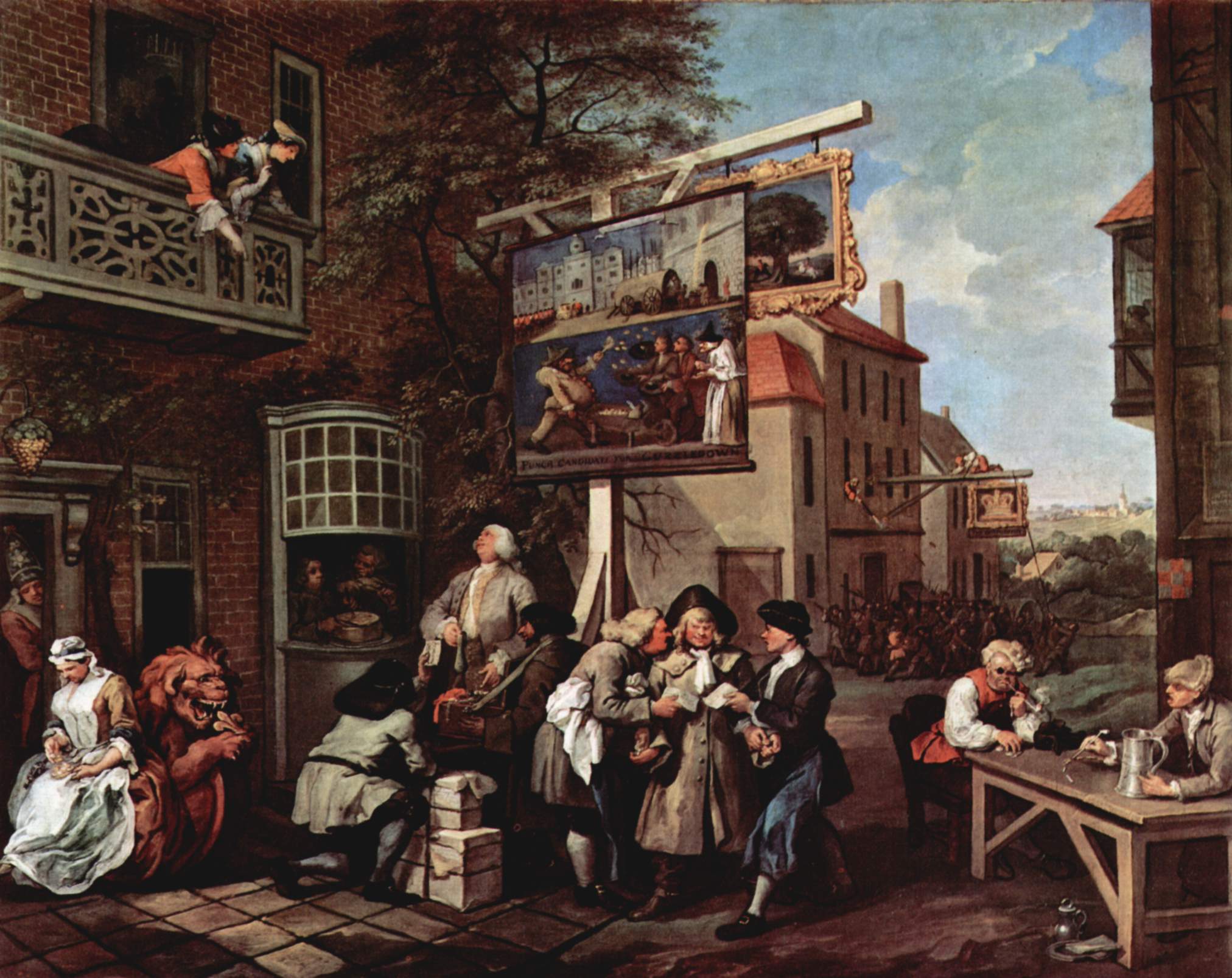
In his blog post, Forsyth goes on to note that in addition to their regionalisation, the parties are also competing ever more narrowly on topics that benefit them and their perceived target voters.  This is a point which Andrew Rawnsley explores in more depth in his piece for the Observer.  From David Cameron's promise to ring-fence the financial well-being of older voters, to Ed Miliband's promise to reduce the tuition fees for students, Rawnsley notes the knock-on effect of such narrowly targeted policies  and compares them, in his opening, with the 18th century image of voter bribery that was illustrated by William Hogarth (in the picture that adorns this post).

The fragmentation of British politics in this way is more likely than ever to produce fissures across the UK landscape, in addition to the huge one that continually threaten to split widely on the northern border.  It may be symptomatic of the current political leaders' loss of faith in their political principles.  It may be the result of their own life-long insularity, which saw their career move through political jobs to youthful party leadership with barely any upsetting intrusion into the grainy, gritty world of most voters.  Such a continuous political trajectory makes them all more susceptible to the statistification of politics, where you look for x thousand votes from a particular group or region to ensure you get those crucial key seats that give you a majority.  The Guardian's Rafael Behr commented on this aspect earlier this week.

Every election is important.  It is just that some are more likely than others to be watersheds.  1945 and 1979 were classic examples of ideological watersheds; without much ideology on the table, 2015 might be a watershed for the very structure of the British polity itself.


Electoral Domesday - could the next government be the second and fourth placed parties?

It was conventional wisdom that the AV referendum in 2011 had effectively 'parked' the issue of electoral reform for a generation or so.  Just, of course, as it was conventional wisdom that the Scottish referendum would also 'park' the issue of Scottish independence.  Neither of these wisdoms look very secure now.  In the case of Scotland, the problem was that the referendum was never allowed to run its proper course as with a week to go David Cameron and his fellow English party leaders changed the issue to something that wasn't on the ballot paper - gerrymandering of a high order.  In the case of electoral reform, Professor John Curtice's interesting figures look as if they too could bring the issue of reform firmly back into the main stream - and, since they were published by the Electoral Reform society that's probably what they were intended to do.

Professor Curtice notes that the key factor for success in the First Past the Post system is the geographic concentration of votes, and he further adds that this is effectively undermining the national claim of the system to be a "winner takes all" one.  His findings (full report here; Electoral Reform summary here) suggest the possibility of a Labour Party which comes second in votes securing the highest number of seats, and being shoehorned into government by an SNP which may well have come only sixth in terms of UK-wide votes, but have enough seats to secure Labour a majority in a coalition.

Curtice looks at the relative prospects of the smaller parties, on whom much of the election outcome will depend, and finds that the SNPs geographic concentration of votes could well propel them into winning significantly higher numbers of seats than the more geographically spread UKIP, even if UKIP scores significantly more votes.  To add to the possible post-election chaos is, of course, the fact that not only will SNP MPs only hail from one part of the UK, but - since the notorious devolution 'vow' - it is part with barely any domestic issues actually decided at Westminster.

Curtice discussed his report on the 'Today' programme (scroll in to around 45.55 minutes) and it makes fascinating listening.  No longer is the issue of whether FPTP throws up another coalition the only point of discussion.  Just as crucial, given the SNP surge in support (largely at Labour's expense in Scotland) is the question of who the coalition might actually comprise.  Thus, to the disproportionality of FPTP is added the unresolved headache of an incomplete devolution settlement.

If this looks like an issue of unfairness to the main parties - and I suspect it is the Tories who would make the most ground on this - then they might like to reflect that their own leaders have led them to this potential impasse.  All three leaders were guilty of panicking att he sight of the Scottish referendum polling figures, and unforgivably altered the basis of the referendum with no thought to the consequences.  In addition, only Clegg campaigned for reform of the Westminster system when he argued for the AV option in the referendum, although his acceptance of a hopelessly skewed referendum question (which only posited AV as an alternative, rather than the principle of proportionality) showed, at best, considerable political naivety.  David Cameron and the rest of the Conservative Party, meanwhile, have consistently failed to consider the inequities of the FPTP system, and then fell foul of their coalition partners in the tit-for-tat of blocking Lords reform (the Conservatives) and constituency boundary changes (the Lib Dems).

Whatever mess emerges after the next election, it is an irony that the men responsible for its genesis will also be the ones charged with resolving it.


So could Clegg be PM after the election?

Well yes, for a few days, is the broad theme of a Huffington Post "exclusive" today.  The piece is an interview with former Lib Dem Defence minister Nick Harvey, who speculates that if David Cameron decided to resign as Conservative leader following a poor showing in the election, a hung parliament could result in coalition negotiations taking place with Nick Clegg holding the fort as interim Prime Minister.  Far-fetched?  Absolutely.  And we still have three months or so of wild speculation making headlines as news 'fact'.

The problem for Clegg, anyway, seems to lie closer to home.  I've always maintained that if disillusioned Lib Dem voters voted Labour, as a protest against the Lib Dems' willingness to be in coalition with the Conservatives, then many of their seats would actually fall not to Labour but to the Conservatives, from whom the incumbent MPs took the setas in the first place.  Clegg's Sheffield Hallam seat is one example - once a Tory stronghold, he seized it from them in 2005.  However, a Survation poll of the seat, reported on Labourlist, puts Labour ahead of Clegg in that seat.  If there is a momentum towards the Labour candidate there, then it certainly seems likely that the anti-coalition vote might be able to coalesce around him to the extent that it takes the seat and deprives Clegg of any further involvement in negotiating new coalitions.  Nevertheless, it is still worth remembering that the seat is a prosperous, and actually quite rural one; certainly not natural Labour territory under a left-wing leader.  I wouldn't write off either Clegg or the Tories just yet.

CORRECTION: I have said in the post above that Nick Clegg won the Hallam seat in 2005 from the Tories.  In fact, he succeeded Liberal Democrat MP Richard Allan, who won it off the Tories in the meltdown of 1997.

Nick Clegg has also now gone on record to ridicule the Survation poll findings.


The Tories remain in their laager, despite not shifting in the polls

Business leaders like Stuart Rose of Marks and Spencer have been leaping in to the political arena to attack Labour's policy proposals, but it doesn't look as if this is doing much to shift the Tory position.  It has been flat-lining at around 32% for a year now.  Admittedly, Labour too has failed to shift things, remaining a mere 1% ahead of the Conservatives in the first month of this year, despite the high-energy campaigning.

It is more than probable that despite the attention being focused on the election - still over three months away - in the Westminster village, few ordinary voters are taking much notice. The biggest electoral trend has been the increase of the SNP's position in Scotland, which is likely to act to the detriment of Labour, but could cause a significant problem for all of the English parties when it comes to getting English legislation through parliament (a difficulty highlighted today by William Hague's inability to unite the parliamentary party behind his English laws proposal).

The Conservatives can draw little comfort from Labour's position in Scotland.  They remain under threat from UKIP, but more importantly have failed to move their opinion poll position despite concerted efforts to do so and the running of a narrative that seeks to confer on Cameron the benefits of incumbency whilst targeting Miliband as unfit to be Prime Minister.

Adam Bienkov has a piece on Politics.co.uk today analysing the polling situation, and he has this cutting but on the nail comment about the Tory party:

After a year of strong economic recovery and declining trust in Labour and Miliband, any other governing party would expect to be sweeping up support by now. The fact that voters would still rather plump for almost any other party instead, suggests that the Tories have fundamental problems they are simply refusing to face up to.
There are occasionally signs of realisation. The party's continuing low support among the young, ethnic minorities, working class voters and indeed anyone outside the South East of England, have been repeatedly raised by some figures on the fringes of the party. Occasionally these concerns are listened to. Usually they are ignored.
In fact rather than face up to these problems they have instead retreated back to the same electoral comfort zone that has failed to win them a majority for over twenty years. Endlessly banging on about immigration, Europe and welfare have failed to win dividends for the party for decades and yet they continue to do it anyway.
They say madness is doing the same thing over and over again while expecting a different result. Well the Tories have been doing the same thing for almost a quarter of a century now and yet still they stand back in amazement when the opinion polls refuse to budge.

This absolutely encapsulates the Tory problem, as I mentioned in an earlier blog post.  Their failure to reach out to a wider electorate remains their Achilles heel, and yet they persistently look to the wrong answer - the belief that they just need to be more right-wing.  How many election defeats will it take for the moderate right to re-group and form a genuinely popular centre-right party?

Labour's election nightmare

You might have thought that the Syriza victory in Greece would have given Labour a bit of a lift.  After all, here was electoral proof that anti-austerity campaigning worked.  In one of the hardest hit countries of them all too.  Instead, it provoked a debate about Labour's political caution that then lapped over into their heartland topic of the NHS.

The Guardian's Zoe Williams used the syriza victory to ask why Labour wasn't taking a leaf out of their Greek counterparts' playbook and pursuing a more radical line in "standing up to the moneymen".  Must have been music to Ed Miliband's ears.  Or not, perhaps, for as the New Statesman's Anoosh Chakeelian noted, Mr. Miliband was slow and cautious in his own response to the triumph of the Greek left.

Then the NHS reared its head.  Labour have been playing this as a key election winner for them for ages.  Alas, when shadow Health Secretary Andy Burnham appeared on Newsnight on Tuesday, it was  to give a disastrous and bad-tempered interview which saw him cornered by Kirsty Wark over the issue of just how much private provision might be acceptable in a Labour run NHS.  This caused the Telegraph's commentator on all things Labour, Dan Hodges, to predict a Cameron victory in May, not least because of Labour's inability to come up with a decent and consistent narrative on the NHS.

And the battle just keeps on raging.  After Alan Milburn attacked the Labour strategy on the NHS, the fight was joined by Roy Hattersely, defending Miliband against Milburn.  Even the Labour's most admired 'lost leader', Alan Johnson, is rumoured to be muttering about the party's dark mood.  Anyway, for a bit of light relief, here's that Burnham interview again, just in case you'd forgotten the clear, lucid and calm defence he offers which is clearly going to see the Tories into the electoral ditch.

Designed with by Way2themes | Distributed by Blogspot Themes